

Cream of Earl Grey is a completely new tea experience for me. Growing up, I my Mom only drank orange pekoe tea (Red Rose, available only in Canada!). I had no idea any other type of tea existed. As I got older, and my sheltered world expanded a bit, I discovered. A few other types of tea, like green and chamomile. Then the tea movement happened, and kaboom! There were hundreds of types of tea everywhere. I tried a wide range of tropical, fruity, interesting teas. Because of the exciting teas, I never gave traditional teas a second look. I just figure they’re all blah like orange pekoe, and haven’t bothered. Until today, with my Cream of Earl Grey.
It does have a traditional tea taste, which isn’t really, pardon my pun, my cup of tea. I picture the Queen drinking this tea. With that being said, I can appreciate…
View original post 52 more words
Share this:

If you’re a foodie, like me, then you know salted caramel is all the rage right now. Pfft. I caught on to the salty/sweet magic when I was younger and loved to have a chocolate bar with a bag of salt and vinegar chips. Flavour magic!
David’sTea has brought the marriage of salty and sweet to a whole new level with Salted Caramel. This black tea is caramely, without being overly sweet. Then, the salt is there just after you swallow. And I can’t forget to mention how delicious this tea smells. Yum! Good job David!
I give Salted Caramel a 4 out of 5.

Share this:
A Fake TV Show Plane Crash Fooled the News Into Thinking It Was Real
Sometimes things on TV can look so real that we think it’s happening in real life. That’s the magic of the moving pictures! Like this fake plane crash for the TV show Chicago Fire, it fooled the news broadcast WGN-TV and tricked real people on the ground too.
A girl who saw the plane crash from the ground said she thought the terrorist had came back for us! And it was a jarring sight, seeing a plane get split at the wing and land on a sleepy neighborhood street. The WGN-TV news broadcast’s reaction is the best though. As they take a look of the overhead footage, their comments included:
Is that a wing, on top of a car?!
That looks like a giant pole in the middle of the street!
We havent seen any ambulance but we see a fire truck
Can you imagine driving down King Drive and a plane comes down in the middle of the road?
It goes on and it’s all great like that! Plus, you get to see the faces of the newscasters as they realize they’ve been duped by a fake plane crash. Just pure comedic gold. But seriously, what would you do if you saw a plane crash in the middle of your neighborhood? And see something like this:
![cfcrash1[1]](https://robdurdle.com/wp-content/uploads/2012/12/cfcrash11.png?w=590)
NBC Los Angeles has reactions from regular people on the ground too. I know we shouldn’t believe what we see on TV, does that mean we can’t trust real life now either?
Via / A Fake TV Show Plane Crash Fooled the News Into Thinking It Was Real (gizmodo.com)
Related articles
- Chicago Fire’s Fake Plane Crash Fools Reporters (news-star.com)
- “Are you kidding me?” Watch embarrassing moment TV newsreaders mistakenly report film set as real life plane crash (mirror.co.uk)
- Broken News: Local TV Station Reports Staged ‘Chicago Fire’ Plane Crash As Real (deadline.com)
Share this:

Today’s tea is Coco Chai Rooibos. I usually don’t make chai at home, because I prefer it as a latte, and frankly I’m too lazy to mess with warming milk, etc. I like to just pop some tea into a tea ball, fire up the Keurig, and away I go. Today I brewed the Coco Chai Rooibos as is, sipped it, and yup, made it into a latte. It’s delicious! A little watery, but if I had known I was going to make it into a latte, I would have brewed it stronger. This would be a great tea for a cold winter night, if you’re out and about.
I give Coco Chai Rooibos a 3 out of 5.

Share this:
‘Star Trek Into Darkness’ poster: Starfleet in shambles?
Paramount tweeted the first poster for Star Trek Into Darkness, and the evocative image has a decidedly gritty Earthly vibe. The final-frontier franchise built upon the ambitious credo to “go where no man has gone before” is grounded firmly, without any of the Enterprise‘s crew in sight. Instead, we see the back of a Neo-garbed Benedict Cumberbatch, emerging unscathed from urban destruction (of his own making?) and looking out towards a futuristic metropolis. With Cumberbatch standing atop the rubble, the devastation frames him with an iconic emblem. See it below and click on it to see it even larger:
![Star-Trek-Into-Darkness[1]](http://img2-1.timeinc.net/ew/i/2012/12/03/Star-Trek-Into-Darkness.jpg)
As Den of Geek pointed out earlier, the Star Trek poster seems to be borrowing from The Dark Knight Rises, whose poster also features a collapsing urban landscape doubling as recognizable silhouette. Placing a caped figure atop rubble also conjures up images of Batman from The Dark Knight. Of course, Batman was the hero, whereas Cumberbatch’s still-nameless villain (Is it Khan?) has been called a “one-man weapon of mass destruction” and “an unstoppable force of terror from within their own organization.”
Related articles
- First Star Trek Into Darkness Poster Features the Wrath of Cumberbatch (tor.com)
- New Poster Reveals STAR TREK INTO DARK KNIGHT (badassdigest.com)
- The ‘Star Trek Into Darkness’ Teaser Poster Has Arrived (slashfilm.com)
Share this:

Today’s tea is a David’s classic that I had actually never tried, Chocolate Rocket. It’s fitting that I had a mate as I was up at 5 am this morning, on my day off! Chocolate Rocket smells wonderful, very chocolatey. I found it a bit weaker than I normally like my teas, but it was still pretty good. Being a mate, it’s supposed to give you energy, but I didn’t find it as effective as David’s Fruite Mate.
I give Chocolate Rocket a 3.5 out of 5.

Share this:
Rob and I were both stoked when we got the latest David’sTea newsletter, showcasing the advent calendar they released for this holiday season. My dear husband ran right out and bought it for me, much to my delight! It wasn’t until I got looking it over later that I realized I’ve already tried a lot of the teas included, most of them are David’s classics and best loved teas. That’s ok, it’s still. Ice to get a different one every day, try a few new ones, and plus ill have 24 cutesy little cans to use in the craft room afterwards! 😀
The first tea is “Buttered Rum“. If Im not mistaken, i think this black tea was introduced with the winter collection a few years ago and they kept it on as part of the permanent collection because of its popularity (I’m glad they do this with…
View original post 60 more words
Share this:
Netflix Finally Comes to Ubuntu
Ubuntu: Watching Netflix on Linux has always been a pain, since Microsoft Silverlight isn’t available on Linux. The unofficial Netflix app for Ubuntu makes it easy to install Netflix and start watching movies right away.
The app basically packages WINE and Netflix into a simple little desktop app, which you can install through a simple Ubuntu repository. It’ll take up a fair amount of space on your system, but at least you’ll finally be able to stream movies to that Linux-based home theater PC, or your laptop running Ubuntu. All you need to do is run the following two commands, one after the other:
sudo apt-add-repository ppa:ehoover/compholio
sudo apt-get update && sudo apt-get install netflix-desktop
After it finishes installing (give it a few minutes), you can hop into Ubuntu’s Dash and search for “Netflix Desktop,” or launch it from the terminal with netflix-desktop. The first time you launch, it’ll do some extra installation work, but when it’s done, it’ll launch in full screen mode and let you start watching movies. To exit full screen mode, just press F11 (though you can also exit the app entirely with Alt+F4).
Right now, it looks like you can only install the app on Ubuntu, but hopefully some nice folks will find ways to install it on other Linux-based systems. Hit the link to read more.
PPA for Netflix Desktop App | IHeartUbuntu
Share this:
Best Vegan Cheese Sauce Ever.
Vegan Cheese Sauce
makes about 2 cups
- 1 yellow onion, roughly chopped
- 1 red bell pepper, roughly chopped
- 2 cloves garlic, minced
- 1 1/2 Tbsp olive oil
- 3 Tbsp cashews, toasted
- salt/pepper
- 1 cup nutritional yeast
- 1/2 tsp ground sea salt
- Add oil to a saute pan and heat over medium-high heat.
- Once oil is heated, add in your chopped onion and red pepper.
- Season with salt and pepper. Saute vegetables for about 7 minutes, stirring frequently.
- Once vegetables have softened, stir in garlic and cook until fragrant, about 1 minute.
- Transfer your sautéed mixture to a blender.
- To the blender, also add in the nutritional yeast, cashews, and sea salt.
- Blend until smooth. Serve hot or cold.
Share this:
How to Tell When You’re Being Followed (and Get Away Safely)


There’s little more frightening than the sneaking suspicion that someone may be following you, whether it’s on foot or in a car. Here’s how you can tell whether that person behind you is watching you as much as you’re watching them.
Why Would Someone Follow Me? I’m Nobody!
It’s not just spies that get tailed. Law enforcement doesn’t usually waste time and resources following random people, but they’re not the only ones interested in the lives of others. Private detectives, angry exes, friends or family of exes, or even that guy you accidentally cut off changing lanes a few miles back may have been following you this whole time, seething and ready to give you a piece of their mind (or possibly their fists.)
Don’t underestimate how even small things can set dangerous people off. These are the easiest people to identify and avoid. We’re not saying live your life paranoid, and if you can’t think of a reason someone would follow you, odds are you’re not being followed, but we are saying that a little knowledge and awareness of your surroundings at all times goes a very long way.
How to Tell If Someone’s Following You
Let’s be clear: if the professionals are following you, you probably won’t know it. Real spies use a host of tricks to make sure you’ll never know you’re being followed. Multiple operatives observe you, and switch off at predetermined points while a control operative, in contact with everyone in the field, manages their movements. That means the guy that followed you for the past two blocks will pull off at the next exit or pop into the Starbucks you passed for a coffee, and someone else will take over while you wonder where he went. There are some ways to tell is an amateur, random person, or a PI is following you though:
- Stay aware of your surroundings. It’s common sense, but you’d be surprised how many people walk around every day staring at their phones or looking at the sidewalk in front of them, paying no attention to the world around them. Keep your head up, and make note of the people you see and the cars you pass. If you’re not aware of your surroundings, the rest of these tips won’t help you.
- Don’t start looking over your shoulder. Remember, normal people are the ones who do inconspicuous things. Spies and PIs know better than to draw attention to themselves. As soon as you start glancing over your shoulder every three steps, they’ll know you’re suspicious. They’ll likely drop farther back or disengage entirely and pick up later.
-

Start with appearances. Look for a car you’ve never seen before in your neighborhood or along your commute, or make note of a vehicle that seems to be taking all the same turns that you’re taking. The same applies for people. Here’s the catch though: if a road-rager is following you, they’ll just close, which is easy to spot. If someone is actually trying to follow you, they’ll probably drive past you occasionally, then change lanes and fall back. On foot, they’ll walk next to you, or even pass you and take a side street that eventually ends up going the same direction that you’re going. Look out for vehicles that make all the same turns that you do. More Intelligent Life suggests you keep an eye on a person’s shoes. Coats and hats change easily, but shoes? Not so much when you don’t want to lose someone. Photo by Robert Red.
- Slow down. Slow people and vehicles are hard to tail, and risk the exposure of the operative, because they now have to stay near the target. Pull into the right lane and drive the speed limit. See what happens. If you’re on foot, slow down or stand to the side and fiddle with your phone a bit (while keeping an eye on what’s going on around you, of course) and see who slows down with you, or who walks past and then suddenly reappears later. Some people will tell you the opposite: that you should speed up and see if they do too. An amateur would speed up too, but a professional would only speed up if they think you might turn or take an exit, or if you’ll leave their line of sight.
The video above, part of a training series by SAFE International, has some more suggestions to help you figure out whether you’re being followed, and what you should do if you confirm that someone is trailing you.
What You Should Do If You Think You’re Being Followed

If you’ve tried the above and think someone’s on your tail, you have some options.
- Call the police. Do this first. If you think you’re in any kind of real danger, this is the best, first, and probably only course of action you should follow. Additionally if it’s local authorities, they’ll disengage. If it’s another law enforcement agency, they may get pulled over themselves. If it’s a PI or a road-rager or any other civilian after you, the police are the best people to handle the situation. If you’re on a highway, stay on it. If you do get off a main road, drive to the nearest police station.
- Go somewhere public. Public, and with tons of people. Find a crowded restaurant and grab a seat. Order a coffee and read something on your phone. Head into the nearest shopping mall or large, crowded store. This gives you two benefits: first, you have the cover of a lot of people (stick close to the crowds.) Second, you can observe your observer, get their description, and hand it over to the police.
- Don’t panic. Don’t start speeding, or try to make quick turns or duck into alleys. Ducking into the subway before the doors close looks great in the movies, but the smart people already have someone on the train or platform waiting for you. Start speeding, and you’ll just drive into the next tail car’s territory faster. When professionals follow someone, they don’t need to know where you are at all times, they just want to “house” you, or observe your behavior and patterns. If you’re worried it’s an angry ex or someone you cut off, stay on main roads, and if you have to stop, leave plenty of space between you and the car in front of you, just in case you need room to maneuver or drive around it if someone approaches your car.
-
Change your behavior to confuse your follower. If you’re in a car, take the next exit, then get back on the main road. This isn’t something most people would normally do, and if someone follows you off the road and then back onto the highway, you know something’s up. Better yet, they should know you’re on to them, and disengage. Make four right (or left) turns. Few people need to drive or walk in a circle. Image by Oleksiy Mark.
- Change your patterns regularly. Don’t go straight home, especially if you’re worried the person following you intends to harm you. Take a different route home from work than you did yesterday. Go to a restaurant you’ve never been to. If you think someone’s been following you, they’re probably already aware of your patterns, so suddenly taking the freeway home when you normally take side streets may throw them off. Riding the subway uptown when you live downtown will do the same thing. If you think the person wants to harm you follow these tips on avoiding an attack, some of which echo points we’ve made here (staying in public, calling the police, etc.)

Professionals, like PIs, usually won’t interact with you—they just want to know where you’ll be and when so they can plan for later. They’re the people you can throw off with changes to your habits and driving tricks. People who want to hurt you are another matter. Your safety is paramount.
Some people will suggest you follow the follower, but we can’t recommend it. If the person following you means you harm, that’s a very dangerous game you’re playing. You should be focused on getting to a safe place, keeping your head and wits about you. With luck, you’ll never need to worry that someone is following you, but it’s important to be able to tell if someone is, why they’re following you, and how to avoid, deter, or lose them.
Share this:

Crack Almost Any Electronic Safe with the Bounce Technique
If you have a digital safe with a passcode entry, a few things could go wrong. You could forget the code, the electronic mechanism could fail, or someone could change the code without you knowing. In the event you need to break into your own electronic safe, here’s how to do it.
The technique you use to crack an electronic safe is called safe bouncing (which is an accurate name once you see how it’s done). It’s apparently easy enough for a kid to do, but looks like it could take a bit of practice. As you can see in the video above, you literally drop part of the safe against the table (or whatever surface it’s resting upon) while turning the locking knob. If your timing is right, you’ll have turned the knob when the safe’s lock bounces open for a brief moment. This works because many cheaper safes have locks that lift. Better safes have counterweight mechanisms so the lock is held in place even when the safe is moving. You won’t be able to bounce those open, but you’ll have no problem with the lower-end options. If you’re successful, the deadbolts will recede into the safe’s door and you’ll be able to open it up.
While good for those times when you lose your passcode, it’s not so great for those times when someone tries to rob you. If you’re concerned about the safety of a given safe, you might want to try this bouncing technique before your purchase.
Share this:
How to Convince Someone You Work in Their Building.


There are fewer opportunities to put your social engineering skills to the test better than trying to convince someone you work at their establishment. Whether you just want to serve yourself a drink refill at a restaurant or you want to surprise your significant other with a birthday bouquet, here’s how to get in unnoticed.
Project Confidence
If you walk around looking nervous and glancing from side to side, people will be able to tell that you don’t belong. Worse, they may approach you and ask questions. It may be unavoidable, but the most important thing to do if you’re trying to blend into any environment is to look like you belong there. That is, stand up straight, walk confidently like you know where you’re headed (even if you have no idea where this hallway will lead you,) and acknowledge people as they acknowledge you—the way you would in your own office or workplace.
This makes the other people around you subconsciously believe that you’re there for a reason. An old friend of mine who used to do penetration testing and physical security evaluations at large companies found that all too often she could find her way to the CEO’s office to hand-deliver her report just by walking around the building looking like she belonged there.

Take Advantage of Human Nature
The best way to get into a building or office that you want access to is to go in behind someone else. Most people call it “tailgating,” and it’s a serious security issue for offices, apartment complexes, college dorms, anywhere with restricted access, but it’s your best friend here. Photo by Lydia.
It’s easy to slide up to the door when someone else is going in and grab it as it closes, to beg the person going in to hold it for you, or—more often—just walk through while the person just ahead of you walks in. Most of us would consider it rude to just slam a door to a building on someone or let an elevator close when someone is just a step behind us, especially if it’s a secure door where you would otherwise have to fumble for a keycard or other device to get in, so we do the nice thing and hold it open. You may have taken advantage of it on a day where you forgot your badge at work—you can do the same just about anywhere.
Dress the Part
This part requires some familiarity with the place you’re going to visit, but no one is going to believe you work in an office where everyone is wearing shirts and ties if you walk in wearing a polo and jeans. Make sure you dress at or slightly above the dress code for the place you’re visiting. Fewer people will question a person wearing a button-down shirt and a slacks in an office full of polo shirts than will call out the guy wearing cutoff jean shorts and a t-shirt in the same office. It’s also important not to go too far over the dress code: you’ll stick out wearing a tie in an office where everyone wears t-shirts and jeans (although that can work to your advantage, as we’ll discuss later.)
 Be Ready for Questioning
Ideally, you’ll be able to slip into an office and get around to where you need to be without any questioning at all. However, if you’re overdressed, underdressed, or just unlucky enough to run into a curious employee, you need to be ready to deal with it. Photo by lululemon athletica.
If you’re overdressed compared to them, point out that you’re there on an interview and you’re just coming back from/going to get a cup of coffee. Alternatively, if the company you’re visiting has a large office or a whole building, say that you work in another office, or that you only started recently. If asked, “What do you do?” Respond that you work in a department almost every company has, like IT, or human resources. Whatever you say, make sure you have something in mind already. It shouldn’t be scripted, but you should have it ready to go.
If they buy it, ask for directions—you’ll be surprised how often you get them. If they’re not buying it, keep in mind some of these tips to subconsciously persuade people. Mirroring the person’s body language and movements will definitely make them feel at ease, and reciprocating their questions with your own will turn the attention away from you and make them think about how to respond. Ask them what they do and whose team they’re on. Ask them how that’s going, and if recent changes in your department have impacted them at all (note: this is an especially good trick if you claim to be in IT. Almost everyone will take the opportunity to talk or gripe to a new IT staffer about something.)
Remember to Smile
Not always, of course—grinning to yourself will make you stand out—but keeping a relatively upbeat and positive demeanor will make you stand out less than someone who’s hunched over, shifty-eyed, and ducking around corners wearing a Mission: Impossibleserious-face. People by nature avoid confrontation, and you can use this to your advantage by being confident, being positive, and engaging when appropriate.
This isn’t the movies: your goal is not to be so convincing that you could charm everyone, you just want to get in, surprise your fiancee in front of her coworkers, or drop off your boyfriend’s lunch without him or his coworkers knowing, and leave without attracting attention to yourself. Ultimately, you don’t want anyone to know someone who doesn’t belong was even there, even if you were right in front of their face.
Share this:

Persuade People with Subconscious Techniques


The power of persuasion can get you far in this world, even if you’re not in sales, and a few simple communication techniques can go a long way to get someone to agree with you.
Persuasiveness is one of the most important skills anyone can learn because it is useful in countless situations. At work, at home, and in your social life, the ability to be persuasive and influence others can be instrumental for achieving goals and being happy.
Learning about the tricks of persuasion can also give you insight into when they’re being used on you. The biggest benefit of this is that money will stay in your pockets as you realize just how sales people and advertisers sell you products that you don’t necessarily need.
Framing is a technique often used in politics. A popular example of framing is inheritance taxes. Politicians who are opposed to inheritance taxes will call them death taxes. By using the word death instead of inheritance, all kinds of negative connotations come to mind.
Framing is quite subtle, but by using emotionally charged words, like death, you can easily persuade people to your point of view.
Mirroring
Mirroring someone is when you mimic their movements. The movement can be virtually anything, but some obvious ones are hand gestures, leaning forward or away, or various head and arm movements. We all do this unconsciously, and if you pay attention you’ll probably notice yourself doing it, I know I have.
How to mirror someone is self explanatory, but a few key things to remember are to be subtle about it and leave a delay between the other person’s movement and your mirroring, 2-4 seconds works best.
Scarcity
This is one that advertisers use a lot. Opportunities, whatever they are, seem a lot more appealing when there is a limited availability.
This can be useful to the average person in the right situation, but even more importantly, this is a method of persuasion to be aware of. Stop and consider how much you’re being influenced by the fact that a product is scarce. If the product is scarce, there must be a ton of demand for it right?

It’s the old saying, “Do unto others…”. When someone does something for us, we feel compelled to return the favor. So, if you want someone to do something nice for you, why not do something nice for them first. In a business setting, maybe you pass them a lead. If at home, maybe it’s you letting the neighbour borrow the lawn mower. It doesn’t matter where or when you do it, the key is to compliment the relationship.Timing
People are more likely to be agreeable and submissive when they’re mentally fatigued. Before you ask someone for something they might not be quick to agree to, try waiting until a more opportune time when they’ve just done something mentally taxing. This could be at the end of the work day when you catch a co-worker on their way out the door. Whatever you ask, a likely response is, “I’ll take care of it tomorrow.”
Congruence
We all try, subconsciously, to be consistent with previous actions. One great example is a technique used by salespeople. A salesperson will shake your hand as he is negotiating with you. In most minds, a handshake equates to a closed deal, and so by doing this before the deal is reached, the salesperson is much more likely to negotiate you in to a closed deal.
A good way to use this yourself is to get people acting before they make up their minds. If, for example, you were out and about with a friend and you wanted to go see a movie but the friend was undecided, you could start walking in the direction of the theatre while they make up their mind.
Fluid Speech
When we talk, we often use little interjections and hesitant phrases such as “ummm” or “I mean” and of course there is the ubiquitous “like”. These little conversation quirks have the unintended effect of making us seem less confident and sure of ourselves, and thus less persuasive.
If you’re confident in your speech, others will be more easily persuaded by what you have to say.
Herd Behavior
We are all natural born followers. It’s sad but true. We constantly look to those around us to determine our actions; we have the need for acceptance.
A simple, effective way to use this to your advantage is to be a leader, let the herd follow you.
Friends and Authorities
We are far more likely to follow or be persuaded by someone we like or by someone who is in an authority position. Not only is this a good one to be aware of to combat persuasive techniques being used on you, it’s also a good one to use on others because you would be surprised how easy it is to get people to like you and establish authority within groups.
Related articles
- The Art of Persuasion in Language (hubba.com)
- Jedi Mind Tricks: 17 Ways to Persuade People (mryoungscholar.wordpress.com)
- Mass Persuasion, One User At A Time (techcrunch.com)
- Use the Force (frugal2free.typepad.com)
- All About What Persuasive Speaking Is (speakingskills2020.typepad.com)
- Politicians and Persuasion: When to Use Abstract Versus Specific Messages (bobsutton.typepad.com)
- Negotiation (lawschooldisrupt.com)
Share this:

Browse Like Bond: Use Any Computer Without Leaving a Trace with Tails


If James Bond logs on to a computer, he doesn’t want to leave a bunch of files, cookies, or his IP address out there for someone to find. It might seem extreme, but sometimes it’s a good idea to take the same precautions yourself.
In this post, we’ll walk through how to use a USB stick or DVD to anonymize, encrypt, and hide everything you do on a computer no matter where you are. When we say “browse without leaving a trace”, we truly mean it. Using the Linux-based, live-boot operating system Tails (The Amnesiac Incognito Live System), you can use any computer anywhere without anyone knowing you were ever on it. Tails is a portable operating system with all the security bells and whistles you’ll ever need already installed on it. You can install Tails on one of your many dust-gathering USB drives or a DVD. We’ll show you how to set up your own portable boot disc in the second section, but let’s start by taking a look at what you get with Tails.
What Tails Is and What’s Packed Into It
The magic of Tails is that you don’t have to do a lick of work: once you create your boot disc you’ll have a completely anonymous, totally private operating system preloaded with all the software you (or James Bond) would need. What’s packed into it? Let’s take a look.
The Software Packed Directly into Tails
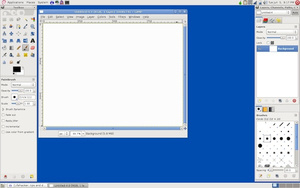 Once you create your Tails boot disc, you’ll be ready to reboot your computer into an encrypted and private operating system preloaded with all the software you’ll need to browse the web, email, IM, and edit documents. Regardless of whether you choose a DVD or USB nothing you do is left on the computer you booted from.
- Built-in online anonymity: The key feature that’s going to appeal to most people is Tails’ built-in online anonymity. This comes in the form of the customized web browser Iceweasel built using the anonymous web browsing technology from Tor. The browser also includes popular security extensions like HTTPS Everywhere for secure browsing, Adblock Plus to block ads, and NoScript to block Java and Flash. Other than those features, the web browser works exactly like you’d expect a web browser to work.
- Built-in encrypted email and chat: Additionally, you also get encrypted and private messaging. Tails includes the Claws email client with OpenPGP for email encryption and the instant messaging client Pidgin with an OTR cryptography tool that encrypts your IM conversations.
- Built-in file encryption: When boot Tails from a USB drive instead of a DVD, you can save documents to the thumb drive and they’re automatically encrypted using an encryption specification called LUKS. (Since the DVD is read-only, you can’t save any files—which is its own form of security.)
- A full suite of editing software: On top your web access being private you also get a full suite of work and creative software. Tails comes preloaded with Openoffice for editing documents, Gimp for editing photos, Audacity for editing sound, and plenty more additional software.
Now let’s walk through how to set up a boot disc for yourself.
Step-by-Step Guide to Set Up Your Own Tails DVD or USB Drive
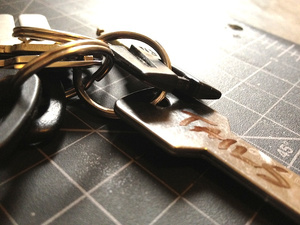 Tails is pretty easy to set up on your own and it doesn’t differ much from setting up any other Linux Live CD. However, a few extra steps do exist to verify your download.
Step 1: Download the Necessary Files
You need to download two different files to get started with Tails: an ISO (an image of Tails that is burned to a disc) and a cryptographic signature to verify the ISO image:
- The ISO Image (Direct download / Torrent)
- Cryptographic Signature (Direct download / Torrent)
The developers behind Tails recommend you verify your Tails ISO to make sure it’s an officially released version that hasn’t been tampered with. We won’t walk through that process here, but they have instructions on their web site for Windows and Mac or Linux.
Step 2: Burn Tails to a CD/DVD
You can find documentation for creating a Tails USB from scratch on each operating system here. Alternately, you can more easily make bootable USB installation of Tails after you boot from a Tails live DVD. For our purposes we’re going to burn Tails to a bootable DVD because it’s an easier process than creating a USB stick from scratch.
On Windows: Right-click the ISO image, select Burn Disc Image, select your DVD drive.
On Mac: Right-click the ISO image, select Burn “tails…” to Disc, select your DVD drive.
Once it’s finished burning let’s boot into Tails and kick the tires.
Step 4: Boot into Tails
Stick your Tails DVD, CD, or thumb drive into your computer and reboot. The process for booting into a disc or external drive depends on your system, so lets look at how to do it on Windows and Mac.
On a Windows System: Different Windows computers have different default settings for booting from an external drive. If yours doesn’t already check for a boot DVD first you can always edit the BIOS boot order (often the DEL key at startup) to make sure your computer looks for a CD or USB before it starts. Alternately, you can closely watch the BIOS screen at the beginning of your computers startup for the Boot options shortcut (usually one of the function keys). When you get to the boot option menu, select your DVD drive and you’ll boot into Tails.
On a Mac System: When you turn on your Mac immediately press and hold down the Option key to access the Startup Manager. Select the Tails DVD (the description will actually say “Windows”) and you’ll boot into Tails.
Step 5 (Optional): Clone the DVD onto a USB Drive
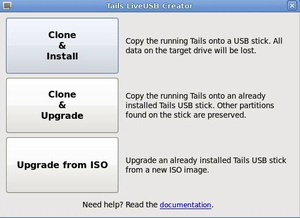 Now that you’re booted into Tails it’s easy to clone your boot DVD onto a USB drive directly from the Tails operating system. Here’s what you need to do:
- Connect your USB drive to your computer.
- Select Applications > Tails > Tails USB Installer.
- Click the Clone and Install Button.
- Select your USB drive, click “Create Live USB Drive” and let the program run.
When the installation is complete you’ll have a bootable USB drive. The benefit of the USB drive is that any files you create in Tails are saved and encrypted directly on your device. However, a USB drive could theoretically be hacked into if you leave it around which is why the ultra-paranoid might prefer a read-only DVD for Tails.
Also, Macs don’t support USB booting without downloading and installing additional software called rEFit. This means you have to download and install rEFit on every Mac you want to boot into Tails from a USB drive.
Creating a bootable Tails disc is a simple process and a great use for one of those USB drives you have laying around doing nothing. Since you can use Tails on about any public computer you run into it’s a great way to keep your browsing and usage hidden from the world. It’s even beneficial on your home computer since you don’t have to alter your system in any way.
Related articles
- Skyfall – Cyber War Becomes Cool (infosecprofessional.com)
Share this:

Ain’t no Rest for the Wicked.
I like to kick this on in the background when its 10 pm, I’m still at work, and I can’t see the light at the end of the tunnel.

I found this band via Pandora, which sadly isnt available in Canada-Land, due to stupid DMCA rules.
When Music Becomes Illegal, only the outlaws will have Music.
Share this:

Danger Mouse, Daniele Luppi – Two Against One ft. Jack White
Jack White has an uncanny ability to pick a random artist and make something even more beautiful than either artist could create on their own.
Amazing.
Lyrics :
Make no mistake I don’t do anything for free
I keep my enemies closer than my mirror ever gets to me
And if you think that there is shelter in this attitude
Wait til you feel the warmth of my gratitude.
One, I get the feeling that it’s two against one.
I’m already fighting me, so what’s another one?
The mirror is a trigger and your mouth’s a gun.
Lucky for me, I’m not the only one.
And if it looks to me like you in your reflection
Plan to add your own fight to this dimension.
Then tell it that this ain’t no free-for-all to see,
There’s only three
IT’S JUST YOU AND ME AGAINST ME…
One, I get the feeling that it’s two against one.
I’m already fighting me, so what’s another one?
The mirror is a trigger and your mouth’s a gun.
lucky for me, I’m not the only one.
Lucky for me, I’m not the only one.
And if your foot’s on to sick a thousand “yes men”
Brand or brake into the middle of this little plan…
Then there’s your plan to hear me say,
That I won’t play around the way, anyway
I plan to plan around them.
One, I get the feeling that it’s two against one.
I’m already fighting me, so what’s another one?
the mirror is a trigger and your mouth’s a gun.
lucky for me, I’m not the only one.
Lucky for me, I’m not the only one. .
Related articles
- The Black Keys’ Want Danger Mouse For Next Album, May Be Busy With U2, “Hopefully He Has Time” (kroq.cbslocal.com)
Share this:
How to Take Constructive Criticism Like a Champ

I’ve always envied people who can graciously accept constructive criticism. It seems I was not born with that trait, and throughout my career I’ve struggled with receiving feedback, even when it was entirely accurate. At the moment I hear the words of critique, my heartbeat quickens and my mind begins to race—first in search of an explanation for this assault on my person and then for a retort to rationalize whatever actions are in question.
And I’m not alone. Unfortunately, in the heat of the moment, many of us react with defensiveness and anger or—even worse—attack the person giving us feedback. But the truth is, we need to get over it. We know there’s value in constructive criticism—how else would we identify weaknesses and areas of improvement? Being able to handle it calmly and professionally will only help us maintain relationships and be more successful in everything we do.
So how do you learn to back off the defensive? The next time you receive constructive criticism from your manager or a peer, use this six-step process to handle the encounter with tact and grace.
Stop Your First Reaction
At the first sign of criticism, before you do anything—stop. Really. Try not to react at all! You will have at least one second to stop your reaction. While one second seems insignificant in real life, it’s ample time for your brain to process a situation. And in that moment, you can halt a dismissive facial expression or reactive quip and remind yourself to stay calm.
Remember the Benefit of Getting Feedback
Now, you have a few seconds to quickly remind yourself of the benefits of receiving constructive criticism—namely, to improve your skills, work product, and relationships, and to help you meet the expectations that your manager and others have of you.
You should also try to curtail any reaction you’re having to the person who is delivering the feedback. It can be challenging to receive criticism from a co-worker, a peer, or someone that you don’t fully respect, but remember, accurate and constructive feedback comes even from flawed sources.
Listen for Understanding
You’ve avoided your typical reaction, your brain is working, and you’ve recalled all the benefits of feedback—high-five! Now, you’re ready to engage in a productive dialogue as your competent, thoughtful self (as opposed to your combative, Mean Girls self).
As the person shares feedback with you, listen closely. Allow the person to share his or her complete thoughts, without interruption. When he or she is done, repeat back what you heard. For example, “I hear you saying that you want me to provide more detailed weekly reports, is that right?” At this point, avoid analyzing or questioning the person’s assessment; instead, just focus on understanding his or her comments and perspective. And give the benefit of the doubt here—hey, it’s difficult to give feedback to another person. Recognize that the person giving you feedback may be nervous or may not express his or her ideas perfectly.
Say Thank You
Next (and this is a hard part, I know), look the person in the eyes and thank him or her for sharing feedback with you. Don’t gloss over this—be deliberate, and say, “I really appreciate you taking the time to talk about this with me.” Expressing appreciation doesn’t have to mean you’re agreeing with the assessment, but it does show that you’re acknowledging the effort your colleague took to evaluate you and share his or her thoughts.
Ask Questions to Deconstruct the Feedback
Now it’s time to process the feedback—you’ll probably want to get more clarity at this point and share your perspective. Avoid engaging in a debate; instead, ask questions to get to the root of the actual issues being raised and possible solutions for addressing them. For example, if a colleague tells you that you got a little heated in a meeting, here are a few ways to deconstruct the feedback:
- Seek specific examples to help you understand the issue: “I was a little frustrated, but can you share when in the meeting you thought I got heated?”
- Acknowledge the feedback that is not in dispute: “You’re right that I did cut him off while he was talking, and I later apologized for that.”
- Try to understand whether this is an isolated issue (e.g., a mistake you made once): “Have you noticed me getting heated in other meetings?”
- Seek specific solutions to address the feedback: “I’d love to hear your ideas on how I might handle this differently in the future.”
Request Time to Follow Up
Hopefully, by this point in the conversation, you can agree on the issues that were raised. Once you articulate what you will do going forward, and thank the person again for the feedback, you can close the conversation and move on.
That said, if it’s a larger issue, or something presented by your boss, you may want to ask for a follow-up meeting to ask more questions and get agreement on next steps. And that’s OK—it’ll give you time to process the feedback, seek advice from others, and think about solutions.
Constructive criticism is often the only way we learn about our weaknesses—without it we can’t improve. When we’re defensive, instead of accepting and gracious, we run the risk of missing out on this important insight. Remember, feedback is not easy to give and it’s certainly not easy to receive, but it will help us now and in the long run.
Taking Constructive Criticism Like a Champ | The Daily Muse
Nicole Lindsay is a career development expert and working on her first book about women and business school. She lives in Connecticut with your husband, who is the coolest guy in the world, and loves traveling to new places on planes, trains and automobiles. Connect with her at DiversityMBAPrep.comor @MBAMinority.
Check out more advice at the Daily Muse:
3 Ways to Battle the Office Backstabber
A Coworker Got the Promotion I Wanted—Now What?
Image by Lorelyn Medina (Shutterstock).
Related articles
- Taking Constructive Criticism Like a Champ (thedailymuse.com)
- How to Take Constructive Criticism Like a Champ (lifehacker.com)
Share this:

Give Yourself Permission to Suck: It’s The Only Way to Learn
You’ve heard the refrain before: In order to master something, you have to start first, and starting involves being bad at it for a while. Author David Kadavy reminds us that it’s okay to suck at what you do, even if you’re been doing it for a while. Give yourself permissions to suck—if you don’t, you’ll never improve.
In order to be good at anything, you have to suck first, but it’s very tempting to give up and just stop when you realize you suck. You may have heard Ira Glass‘s advice for beginners, seen in the video above and also retold here at Zen Pencils, but the message is the same: if you think you can’t do something, it’s not just possible, it’s probably likely that you just need to keep working to get through the barrier of suckage before you’re any good. Even then, once you’re good, you probably still suck a bit, and that’s okay.
Kadavy explains it like this:
Most people don’t give themselves permission to suck. They think that there are people who are great at things (and are notable for being great at those things), and then there is them: ordinary person – and all of the ordinary people around them.
If they start trying to do something, their ordinary person friends try to push them down “why are you doing that?” “What a waste of time!” “Why don’t you just watch sitcoms and scan Facebook with your free time, fellow ordinary person?”
Unfortunately, most people give in. They can’t stand to suck.
He reminds us that there’s nothing wrong with being bad at something, especially if it’s part of the process you use to learn, grow, and get better. No one is ever a master at anything the first time they try it, even if they have a talent for it. At the end of the day, doing things you’re not that great at—but wish you were—eventually leads you to being better at them, obviously, but more importantly it can be fun and rewarding in itself to master something you’ve always wanted to master.
Plus, the more frequently you make that climb from knowing nothing to knowing something, the easier it is the next time you want to try something new. So give yourself permission to suck, even if other people around you think you’re wasting your time. Learning a skill, like a language, or amateur astronomy, or how to fly a helicopter, are things that are hard and take time, and you’ll suck at them for a long while, but once you don’t suck anymore you’ll have your whole life to enjoy the benefits.
Related articles
- Permission to Suck (kadavy.net)
Share this:
Share this:
Amazing QC Clock… worthless for “real time” time telling, but wow, amazing 🙂
Share this:
What You Can Learn from Your Professional Rivals


Professional rivalries often seem like the ultimate waste of time. Why is she spending so much time worrying about what someone else is doing? Why doesn’t she focus on her own business? Doesn’t she have anything better to do? It’s true that obsessing about a competitor isn’t the healthiest long-term activity. But I’ve also come to believe you can glean important lessons from the very act of rivalry – if you use it as an opportunity for growth, rather than just an opportunity to crush your enemies.
Where are you weak? Oftentimes, rivalry is a form of envy: your competitor has a trait or skill you (sometimes grudgingly) admire. That was the case when a friend – let’s call her Sara – reached out to me, asking if I was connected with a particular colleague on Facebook. “If so,” Sara wrote, “I want to discuss his social media presence with you.” It turned out Sara was livid about this guy’s frequent, self-promoting Facebook posts and wanted validation that our colleague was grossly misusing the network and ruining his personal brand. Unfortunately – to Sara’s astonishment – I hadn’t really noticed. I casually followed his exploits; only Sara was obsessed enough to be bothered. She was a shy, introverted entrepreneur who had long hesitated about promoting herself. Our colleague’s blatant self-promotion raised the uncomfortable specter Sara might have to start doing it, too. She felt much better after realizing it was OK to tackle social media in her own way, that didn’t feel phony or self-aggrandizing.
What do you value most? For years, I’d known a woman whom I was quite sure had fabricated her credentials. She cited ties to world-famous universities and institutions, but grew vague and evasive when asked about them. It was mildly annoying to see her at conferences, but my indignation grew to a fever pitch when she landed a book deal with a major publisher and began winning media attention. In an inspired move, I wrote to my friend Michael, who worked at one of the august institutions she claimed to be affiliated with, in hopes he might devise a clever way to “out” her. Instead, he wrote back with a question: “Why does she irk you?” I wrote back, defensive: It’s about justice! Fairness! Truth! But Michael was right. One’s rivals often poke at a tender spot. I worked hard for my degrees and credentials, never benefiting from family connections or other shortcuts. And perhaps, it seems, I’ve made a religion out of it, because the thought that someone could invent their résumé and get away with it makes me apoplectic. Knowing that bias helps me keep a better perspective (for instance, I may be liable to overvalue a job candidate who “made their own way in the world”).
Are you thinking big enough? At their worst, professional rivalries cause a form of myopia; you’re inventing products or launching initiatives to beat the competition, not to benefit the customer. That’s rarely the recipe for breakthrough innovation, as you focus on one-upmanship and incremental improvements. (Indeed, there’s speculation following Apple’s patent infringement victory against Samsung that smartphone makers may be forced into a new era of design creativity, now that the negative legal consequences of “following the leader” are so clear.) But occasionally, stalking a rival can unlock breakthrough possibilities for growth (think of the impact Roger Bannister shattering the four-minute mile had on his competitors). How can you increase your impact or make a new contribution in your field?
Professional rivalries can be a powerful vehicle for self-discovery – if you step back and think analytically about them. Learning where you’re weak, what values you cherish, and how to think big are important advantages. But even if you struggle to rise to that level of self-reflection when it comes to your rival, the blood-boiling effects of a competitor can sometimes be salubrious: if it kills me, I’m going to make sure my book outsells that of my veracity-challenged rival.
How have professional rivalries inspired or motivated you?
Dorie Clark is a strategy consultant who has worked with clients including Google, Yale University, and the National Park Service. She is the author of the forthcoming Reinventing You: Define Your Brand, Imagine Your Future (HBR Press 2013). Follow her on Twitter@dorieclark.
Image via Dmitry Shironosov (Shutterstock).
Related articles
- What You Can Learn from Your Professional Rivals (updates.lifehacker.com)
- What You Can Learn from Your Professional Rivals (blogs.hbr.org)
Share this:

How To Break Down A Door


Alright, let’s get this out-of-the-way first: kicking down a door is not the best option for opening a locked door. It will damage the door and cost you lots of money to fix it. It is better to call a locksmith, pick the lock, or attempt to crawl in a window.
But let’s say it’s an emergency. You’re in a burning house and you need to escape and the door is on fire. Or your loved ones are in a burning house and you’re locked out. You can’t stand there fiddling with the lock, you’ve got to break it down! Or perhaps a loved one is stricken with a medical emergency and is locked inside a room or in their house. What to do? Be a man, dammit! Break down that door! You know you’ve always wanted to.
How to break down a door
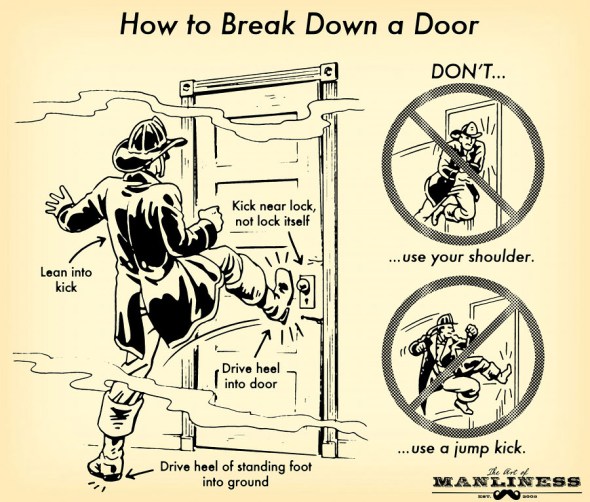
If you have watched enough movies, your next move is a no brainer….run at the door shoulder first, right? Wrong. This technique may be uber-manly, but it will probably dislocate your shoulder. It is better to employ a more forceful and well placed kick.
Check to see which way the door opens by checking the hinges. If the door opens towards you, kicking it down is going to be next to impossible. Kicking a door down is best employed on a door that swings away from you.
Kick to the side of where the lock is mounted (near the keyhole). This is typically the weakest part of the door.
Using a front kick, drive the heel of your foot into the door. Give the kick forward momentum and keep your balance by driving the heel of your standing foot into the ground. Don’t kick the lock itself; this could break your foot.
The wood should begin to splinter. Today most doors are made of soft wood and are hollow. They should give way fairly easily, especially since the lock’s deadlock bolt extends only an inch or less into the door frame. Older, completely solid doors will prove more resistant. Just keep on kicking until the door gives way and you can save the day.
Avoid jump kicks. While you may be tempted to employ this manly move, jumping diminishes your stability which causes you to lose power.
Share this:

Jack White – “ I’m Shakin’ ” Video


Today, Jack White dropped the video for “ I’m Shakin’ ”, the fired-up Little Willie John video that appeared on his still-great album Blunderbuss. White’s been famously touring with two bands lately, one all-male and one all-female. And in the video, two different Whites and both of his bands face off against each other, soundclash-style. Here’s how much of an egalitarian Jack White is: Even his all-male band has girls in it. It’s a fun, stylish video that gets over on White’s rock-star charisma and does not crowd that out with too many extra elements. Dori Oskowitz directs, and you can watch it below.
Blunderbuss is out now on Third Man/Columbia.


 RobDurdle.com

You must be logged in to post a comment.