http://www.youtube.com/p/96FA90BA24F548EA?hl=en_US&fs=1
LA’s Hottest Bartender teaches you how to make a variety of great alcoholic drinks.
http://www.youtube.com/p/96FA90BA24F548EA?hl=en_US&fs=1
LA’s Hottest Bartender teaches you how to make a variety of great alcoholic drinks.
Gaga Stigmata: Critical Writings and Art About Lady Gaga is a new (begun in March), heavily “theory” laden, online journal that takes the much-discussed pop phenomena of the Lady very seriously (or tongue-in-cheek, it’s hard to tell).

Lady Gaga, Pearl Face
In 1957, Frank Herbert was a journalist and writer of short stories, on his way to Florence, Oregon to do an article about the U. S. Department of Agriculture’s attempts to control sand dunes that were shifting. The USDA was searching for something to stabilize the dunes, and they came upon European beach grass. Herbert’s research was for an article tentatively titled “They Stopped The Moving Sands.” The article was never completed, but his research of dune stabilization lead to larger ecological matters, and eventually the novel Dune. This year marks the 45th anniversary that novel. The world of dunes, both fictional and real, has changed quite a bit in the years.
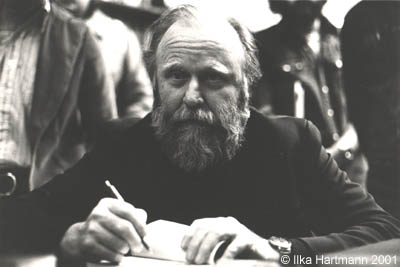
Frank Herbert
Though never completed, They Stopped The Moving Sands (select pages on Google Books) is now a section of The Road to Dune, a companion book to the Dune novels. The section includes the proposal from Herbert to his agent, as well as letters back and forth. Herbert casts the battle against the endless waves of sand in a larger scope, from The Horizon of Aten to the seemingly endless Peruvian dunes. Thomas Flippin of the Soil Conservation Service, director of the efforts to arrest the movement of the sands, commented that “the sand promises a slow death to everything it touches.” As Herbert mentioned in “Dune Genesis” (Google Quickview / PDF), he saw the struggle over the environment as a key issue in future power struggles:
While this concept [of power structures, politics and the mistakes of (super)heroes] was still fresh in my mind, I went to Florence, Oregon, to write a magazine article about a US Department of Agriculture project there. The USDA was seeking ways to control coastal (and other) sand dunes. I had already written several pieces about ecological matters, but my superhero concept filled me with a concern that ecology might be the next banner for demagogues and would-be-heroes, for the power seekers and others ready to find an adrenaline high in the launching of a new crusade.
If not a full crusade, there was the mentality that dunes could be stopped and made into something more permanent. European beach grass was once used as the first of three stages of succession planting (abstract from a 1975 USDA article). Now, this foreign grass is classified as an aggressive invasive species in North America, as is one of the USDA’s earlier choice for succession plants, Scotch Broom.
Oreagon Dunes National Recreation Area was established in 1963, and is now . Some residents one area carved out a community, and formed Dunes City, Oregon that same year. In Colorado, the Great Sand Dunes National Park & Preserve was established as a national monument in 1932, and later expanded into a national park and preserve in 2000-2004.
Elsewhere in the world, shrinking dunes are seen as environmental oases, the last locations for certain species. And ever-shifting dunes can hide armies for centuries, speaking in short to the archaeological potential for deserts and dunes of sorts.
Back to the fictional side: Frank Herbert created a world that Arthur C. Clark likened to The Lord of the Rings, spanning six novels in the “Classic Dune” (works written by Frank Herbert), eleven novels that expanded the universe, written by Herbert’s eldest son, Brian Herbert, and Kevin J. Anderson, plus another six short stories written by the duo. The derivitive works of the Dune universe range from much-despised (see also: the comic book adaptation) to still loved, influential classic (note: earlier RTS games do exist).
“Hello, I’m Johnny Cash.”On January 13, 1968, Johnny Cash played two concerts at Folsom State Prison with June Carter, Carl Perkins, the Statler Brothers, and his band, the Tennessee Three. At Folsom Prison, drawn mainly from the first show, is often ranked as one of the best albums of all time and turned Cash’s career around. Reporter Gene Beley covered the concert and recorded some songs from the audience.
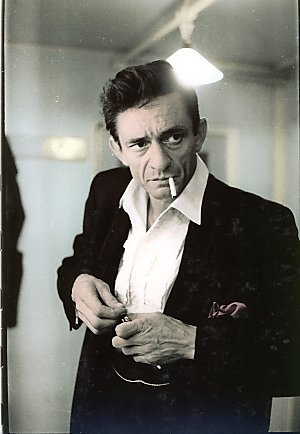 Cash closed both shows with “Greystone Chapel,” written by Folsom inmate Glen Sherley. Cash heard the song for the first time the night before the concerts, and acknowledged Sherley during the shows.
Cash had been playing in prisons since the late 1950s; Merle Haggard saw several of his concerts from the audience at San Quentin. The 1968 concerts were the second time Cash had played at Folsom. He’d done a show there in November 1966. Reverend Floyd Gressett arranged the 1966 concert and gave Cash the tape of “Greystone Chapel” in 1968.
The 1951 movie Inside the Walls of Folsom Prison inspired Cash to write his 1955 single “Folsom Prison Blues” when he was serving in Germany in the US Air Force. The song’s melody and lyrics are very similar to Gordon Jenkins‘ “Crescent City.”
Johnny Cash at Folsom Prison [trailer] is a 2008 documentary about the concerts. (It apparently doesn’t include concert footage.)
In 1969 Cash recorded At San Quentin, which included the hit single “A Boy Named Sue.” In 1973 he recorded På Österåker at Sweden’s Österåker Prison.
Cash’s prison albums started a trend that included B.B. King’s Live in Cook County Jail and Live at San Quentin, John Lee Hooker’s Live At Soledad Prison, Little Milton’s Live at Westville Prison and the Sex Pistols’ Live at Chelmsford Top Security Prison, Thom Chacon’s Live at Folsom Prison, Tracy Nelson’s Live from Cell Block D, and Charles Manson’s Live from San Quentin [AKA White Rasta]. Freddy Fender’s Recorded Inside Louisiana State Prison is a fake live-in-prison album. “If it is a prison recording, then where, praytell, are the prisoners?” AMG
Men singing at women’s prisons was a trend-within-a-trend, with The Moments’ Live at the New York State Women’s Prison, Sonny George’s Live At The Tennessee Prison For Women, Mack Vickery’s Live At The Alabama Women’s Prison. Leona Williams reversed the gender roles with her San Quentin’s First Lady (with Merle Haggard, who’d done time there).
At the time of Cash’s concert, Folsom was a model prison. “Administrators came from New York and Texas to find out how Folsom kept its violence so low and its inmates from coming back.” It’s much worse now.
In honor of what would have been the Man in Black’s 78th birthday on February 26, Flavorwire presents 78 Things You [Probably —Ed.] Didn’t Know About Johnny Cash. Number 14: During his act in the 1950s, Cash flaunted a killer Elvis impersonation. Number 36: An ostrich attack in 1983 left Cash with five broken ribs and internal bleeding.

Perhaps the attack was about Cash’s response to being sued for (Number 32) a forest fire he started in Los Padres National Wildlife Refuge, which (Number 33) killed all but 9 of the endangered condors at the refuge. When questioned about the birds at the deposition, Cash replied: “I don’t give a damn about your yellow buzzards.”
Some of the items on the list aren’t terribly surprising or new, but the few that are are worth it. (Number 64, for example.)
A woman pushing a shopping cart with with bottles and cans in it was hit by a car on Connaught ave this afternoon around 1:20pm. Moncton Fire Dept. & NB Ambulance were on scene along with Codiac Regional RCMP. Police have Connaught Ave blocked between High street and Jones and a traffic analyst was on scene marking where the woman was hit. Windshield was smashed on the vehicle that struck the woman. In the same area there was a crew of city workers patching potholes, road conditions were wet from melting snow, but for the most part good driving conditions. RCMP said the road would be closed off for awhile while they investigate the accident.
UPDATE: The following guide, originally written for Firefox 2, has been used successfully on Firefox 3, Firefox 3.5 and Firefox 3.6. Users of Firefox Portable edition (versions 3, 3.5 and 3.6) also have been successful using this guide.
The Windows computers available at my University permits login only by autenticated users (students) who don’t have Administrator access and permissions.
Installing software on those PC is then not possible.
Recently they finally installed Firefox 2 but without the Flash plugins, which is absolutly useful/needed.
I then tryed to install the Flash Player using the “standard” way (click on the missing plugin link then install the plugin..). However without administrator plugins it was not possible to install.
Then I started doing some tests trying to install the plugin manually. Now I have it installed and working perfectly!
This is how I managed to install it without administrator permissions:
Reference:
Profile folder on MozillaZine Knowledge Base.
Installing Flash in Portable Firefox with no installer at AcidLabs.org Blog.

I lost again.


 RobDurdle.com
You must be logged in to post a comment.