As subtle as a flying brick.

Latest

Persuade People with Subconscious Techniques

Persuasion

The power of persuasion can get you far in this world, even if you’re not in sales, and a few simple communication techniques can go a long way to get someone to agree with you.

Persuasiveness is one of the most important skills anyone can learn because it is useful in countless situations. At work, at home, and in your social life, the ability to be persuasive and influence others can be instrumental for achieving goals and being happy.

Learning about the tricks of persuasion can also give you insight into when they’re being used on you. The biggest benefit of this is that money will stay in your pockets as you realize just how sales people and advertisers sell you products that you don’t necessarily need.

Here are 9 of the best tricks to be persuasive and influence others:Framing 
Framing is a technique often used in politics. A popular example of framing is inheritance taxes. Politicians who are opposed to inheritance taxes will call them death taxes. By using the word death instead of inheritance, all kinds of negative connotations come to mind.

Framing is quite subtle, but by using emotionally charged words, like death, you can easily persuade people to your point of view.

Mirroring 
Mirroring someone is when you mimic their movements. The movement can be virtually anything, but some obvious ones are hand gestures, leaning forward or away, or various head and arm movements. We all do this unconsciously, and if you pay attention you’ll probably notice yourself doing it, I know I have.

How to mirror someone is self explanatory, but a few key things to remember are to be subtle about it and leave a delay between the other person’s movement and your mirroring, 2-4 seconds works best.

Scarcity 
This is one that advertisers use a lot. Opportunities, whatever they are, seem a lot more appealing when there is a limited availability.

This can be useful to the average person in the right situation, but even more importantly, this is a method of persuasion to be aware of. Stop and consider how much you’re being influenced by the fact that a product is scarce. If the product is scarce, there must be a ton of demand for it right?

How to Make Trouble and Influence People

Reciprocation 
It’s the old saying, “Do unto others…”. When someone does something for us, we feel compelled to return the favor. So, if you want someone to do something nice for you, why not do something nice for them first. In a business setting, maybe you pass them a lead. If at home, maybe it’s you letting the neighbour borrow the lawn mower. It doesn’t matter where or when you do it, the key is to compliment the relationship.Timing 
People are more likely to be agreeable and submissive when they’re mentally fatigued. Before you ask someone for something they might not be quick to agree to, try waiting until a more opportune time when they’ve just done something mentally taxing. This could be at the end of the work day when you catch a co-worker on their way out the door. Whatever you ask, a likely response is, “I’ll take care of it tomorrow.”

Congruence 
We all try, subconsciously, to be consistent with previous actions. One great example is a technique used by salespeople. A salesperson will shake your hand as he is negotiating with you. In most minds, a handshake equates to a closed deal, and so by doing this before the deal is reached, the salesperson is much more likely to negotiate you in to a closed deal.

A good way to use this yourself is to get people acting before they make up their minds. If, for example, you were out and about with a friend and you wanted to go see a movie but the friend was undecided, you could start walking in the direction of the theatre while they make up their mind.

Fluid Speech 
When we talk, we often use little interjections and hesitant phrases such as “ummm” or “I mean” and of course there is the ubiquitous “like”. These little conversation quirks have the unintended effect of making us seem less confident and sure of ourselves, and thus less persuasive.

If you’re confident in your speech, others will be more easily persuaded by what you have to say.

Herd Behavior 
We are all natural born followers. It’s sad but true. We constantly look to those around us to determine our actions; we have the need for acceptance.

A simple, effective way to use this to your advantage is to be a leader, let the herd follow you.

Friends and Authorities 
We are far more likely to follow or be persuaded by someone we like or by someone who is in an authority position. Not only is this a good one to be aware of to combat persuasive techniques being used on you, it’s also a good one to use on others because you would be surprised how easy it is to get people to like you and establish authority within groups.


Browse Like Bond: Use Any Computer Without Leaving a Trace with Tails

If James Bond logs on to a computer, he doesn’t want to leave a bunch of files, cookies, or his IP address out there for someone to find. It might seem extreme, but sometimes it’s a good idea to take the same precautions yourself.

In this post, we’ll walk through how to use a USB stick or DVD to anonymize, encrypt, and hide everything you do on a computer no matter where you are. When we say “browse without leaving a trace”, we truly mean it. Using the Linux-based, live-boot operating system Tails (The Amnesiac Incognito Live System), you can use any computer anywhere without anyone knowing you were ever on it. Tails is a portable operating system with all the security bells and whistles you’ll ever need already installed on it. You can install Tails on one of your many dust-gathering USB drives or a DVD. We’ll show you how to set up your own portable boot disc in the second section, but let’s start by taking a look at what you get with Tails.

What Tails Is and What’s Packed Into It

The magic of Tails is that you don’t have to do a lick of work: once you create your boot disc you’ll have a completely anonymous, totally private operating system preloaded with all the software you (or James Bond) would need. What’s packed into it? Let’s take a look.

The Software Packed Directly into Tails

Once you create your Tails boot disc, you’ll be ready to reboot your computer into an encrypted and private operating system preloaded with all the software you’ll need to browse the web, email, IM, and edit documents. Regardless of whether you choose a DVD or USB nothing you do is left on the computer you booted from.
  • Built-in online anonymity: The key feature that’s going to appeal to most people is Tails’ built-in online anonymity. This comes in the form of the customized web browser Iceweasel built using the anonymous web browsing technology from Tor. The browser also includes popular security extensions like HTTPS Everywhere for secure browsing, Adblock Plus to block ads, and NoScript to block Java and Flash. Other than those features, the web browser works exactly like you’d expect a web browser to work.
  • Built-in encrypted email and chat: Additionally, you also get encrypted and private messaging. Tails includes the Claws email client with OpenPGP for email encryption and the instant messaging client Pidgin with an OTR cryptography tool that encrypts your IM conversations.
  • Built-in file encryption: When boot Tails from a USB drive instead of a DVD, you can save documents to the thumb drive and they’re automatically encrypted using an encryption specification called LUKS. (Since the DVD is read-only, you can’t save any files—which is its own form of security.)
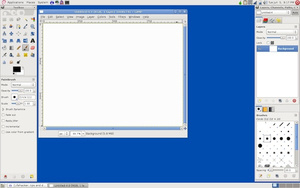
  • A full suite of editing software: On top your web access being private you also get a full suite of work and creative software. Tails comes preloaded with Openoffice for editing documents, Gimp for editing photos, Audacity for editing sound, and plenty more additional software.

Now let’s walk through how to set up a boot disc for yourself.

Step-by-Step Guide to Set Up Your Own Tails DVD or USB Drive

Tails is pretty easy to set up on your own and it doesn’t differ much from setting up any other Linux Live CD. However, a few extra steps do exist to verify your download.
Step 1: Download the Necessary Files

You need to download two different files to get started with Tails: an ISO (an image of Tails that is burned to a disc) and a cryptographic signature to verify the ISO image:

  1. The ISO Image (Direct download / Torrent)
  2. Cryptographic Signature (Direct download / Torrent)

The developers behind Tails recommend you verify your Tails ISO to make sure it’s an officially released version that hasn’t been tampered with. We won’t walk through that process here, but they have instructions on their web site for Windows and Mac or Linux.

Step 2: Burn Tails to a CD/DVD

You can find documentation for creating a Tails USB from scratch on each operating system here. Alternately, you can more easily make bootable USB installation of Tails after you boot from a Tails live DVD. For our purposes we’re going to burn Tails to a bootable DVD because it’s an easier process than creating a USB stick from scratch.

On Windows: Right-click the ISO image, select Burn Disc Image, select your DVD drive.

On Mac: Right-click the ISO image, select Burn “tails…” to Disc, select your DVD drive.

Once it’s finished burning let’s boot into Tails and kick the tires.

Step 4: Boot into Tails

Stick your Tails DVD, CD, or thumb drive into your computer and reboot. The process for booting into a disc or external drive depends on your system, so lets look at how to do it on Windows and Mac.

On a Windows System: Different Windows computers have different default settings for booting from an external drive. If yours doesn’t already check for a boot DVD first you can always edit the BIOS boot order (often the DEL key at startup) to make sure your computer looks for a CD or USB before it starts. Alternately, you can closely watch the BIOS screen at the beginning of your computers startup for the Boot options shortcut (usually one of the function keys). When you get to the boot option menu, select your DVD drive and you’ll boot into Tails.

On a Mac System: When you turn on your Mac immediately press and hold down the Option key to access the Startup Manager. Select the Tails DVD (the description will actually say “Windows”) and you’ll boot into Tails.

Step 5 (Optional): Clone the DVD onto a USB Drive

Now that you’re booted into Tails it’s easy to clone your boot DVD onto a USB drive directly from the Tails operating system. Here’s what you need to do:

  1. Connect your USB drive to your computer.
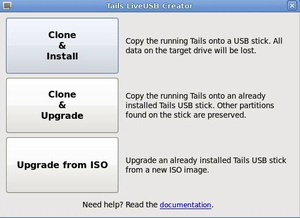
  2. Select Applications > Tails > Tails USB Installer.
  3. Click the Clone and Install Button.
  4. Select your USB drive, click “Create Live USB Drive” and let the program run.

When the installation is complete you’ll have a bootable USB drive. The benefit of the USB drive is that any files you create in Tails are saved and encrypted directly on your device. However, a USB drive could theoretically be hacked into if you leave it around which is why the ultra-paranoid might prefer a read-only DVD for Tails.

Also, Macs don’t support USB booting without downloading and installing additional software called rEFit. This means you have to download and install rEFit on every Mac you want to boot into Tails from a USB drive.


Creating a bootable Tails disc is a simple process and a great use for one of those USB drives you have laying around doing nothing. Since you can use Tails on about any public computer you run into it’s a great way to keep your browsing and usage hidden from the world. It’s even beneficial on your home computer since you don’t have to alter your system in any way.

Ain’t no Rest for the Wicked.

I like to kick this on in the background when its 10 pm, I’m still at work, and I can’t see the light at the end of the tunnel.

Ain't No Rest for the Wicked

I found this band via Pandora, which sadly isnt available in Canada-Land, due to stupid DMCA rules.

When Music Becomes Illegal, only the outlaws will have Music.

Danger Mouse, Daniele Luppi – Two Against One ft. Jack White

Jack White has an uncanny ability to pick a random artist and make something even more beautiful than either artist could create on their own.

Amazing.

Lyrics :

Make no mistake I don’t do anything for free
I keep my enemies closer than my mirror ever gets to me
And if you think that there is shelter in this attitude
Wait til you feel the warmth of my gratitude.

One, I get the feeling that it’s two against one.
I’m already fighting me, so what’s another one?
The mirror is a trigger and your mouth’s a gun.
Lucky for me, I’m not the only one.

And if it looks to me like you in your reflection
Plan to add your own fight to this dimension.
Then tell it that this ain’t no free-for-all to see,
There’s only three

IT’S JUST YOU AND ME AGAINST ME…

One, I get the feeling that it’s two against one.
I’m already fighting me, so what’s another one?
The mirror is a trigger and your mouth’s a gun.
lucky for me, I’m not the only one.
Lucky for me, I’m not the only one.

And if your foot’s on to sick a thousand “yes men”
Brand or brake into the middle of this little plan…
Then there’s your plan to hear me say,
That I won’t play around the way, anyway
I plan to plan around them.

One, I get the feeling that it’s two against one.
I’m already fighting me, so what’s another one?
the mirror is a trigger and your mouth’s a gun.
lucky for me, I’m not the only one.
Lucky for me, I’m not the only one. .


How to Take Constructive Criticism Like a Champ

I’ve always envied people who can graciously accept constructive criticism. It seems I was not born with that trait, and throughout my career I’ve struggled with receiving feedback, even when it was entirely accurate. At the moment I hear the words of critique, my heartbeat quickens and my mind begins to race—first in search of an explanation for this assault on my person and then for a retort to rationalize whatever actions are in question.

And I’m not alone. Unfortunately, in the heat of the moment, many of us react with defensiveness and anger or—even worse—attack the person giving us feedback. But the truth is, we need to get over it. We know there’s value in constructive criticism—how else would we identify weaknesses and areas of improvement? Being able to handle it calmly and professionally will only help us maintain relationships and be more successful in everything we do.

So how do you learn to back off the defensive? The next time you receive constructive criticism from your manager or a peer, use this six-step process to handle the encounter with tact and grace.

Stop Your First Reaction

At the first sign of criticism, before you do anything—stop. Really. Try not to react at all! You will have at least one second to stop your reaction. While one second seems insignificant in real life, it’s ample time for your brain to process a situation. And in that moment, you can halt a dismissive facial expression or reactive quip and remind yourself to stay calm.

Remember the Benefit of Getting Feedback

Now, you have a few seconds to quickly remind yourself of the benefits of receiving constructive criticism—namely, to improve your skills, work product, and relationships, and to help you meet the expectations that your manager and others have of you.

You should also try to curtail any reaction you’re having to the person who is delivering the feedback. It can be challenging to receive criticism from a co-worker, a peer, or someone that you don’t fully respect, but remember, accurate and constructive feedback comes even from flawed sources.

Listen for Understanding

You’ve avoided your typical reaction, your brain is working, and you’ve recalled all the benefits of feedback—high-five! Now, you’re ready to engage in a productive dialogue as your competent, thoughtful self (as opposed to your combative, Mean Girls self).

As the person shares feedback with you, listen closely. Allow the person to share his or her complete thoughts, without interruption. When he or she is done, repeat back what you heard. For example, “I hear you saying that you want me to provide more detailed weekly reports, is that right?” At this point, avoid analyzing or questioning the person’s assessment; instead, just focus on understanding his or her comments and perspective. And give the benefit of the doubt here—hey, it’s difficult to give feedback to another person. Recognize that the person giving you feedback may be nervous or may not express his or her ideas perfectly.

Say Thank You

Next (and this is a hard part, I know), look the person in the eyes and thank him or her for sharing feedback with you. Don’t gloss over this—be deliberate, and say, “I really appreciate you taking the time to talk about this with me.” Expressing appreciation doesn’t have to mean you’re agreeing with the assessment, but it does show that you’re acknowledging the effort your colleague took to evaluate you and share his or her thoughts.

Ask Questions to Deconstruct the Feedback

Now it’s time to process the feedback—you’ll probably want to get more clarity at this point and share your perspective. Avoid engaging in a debate; instead, ask questions to get to the root of the actual issues being raised and possible solutions for addressing them. For example, if a colleague tells you that you got a little heated in a meeting, here are a few ways to deconstruct the feedback:

  • Seek specific examples to help you understand the issue: “I was a little frustrated, but can you share when in the meeting you thought I got heated?”
  • Acknowledge the feedback that is not in dispute: “You’re right that I did cut him off while he was talking, and I later apologized for that.”
  • Try to understand whether this is an isolated issue (e.g., a mistake you made once): “Have you noticed me getting heated in other meetings?”
  • Seek specific solutions to address the feedback: “I’d love to hear your ideas on how I might handle this differently in the future.”

Request Time to Follow Up

Hopefully, by this point in the conversation, you can agree on the issues that were raised. Once you articulate what you will do going forward, and thank the person again for the feedback, you can close the conversation and move on.

That said, if it’s a larger issue, or something presented by your boss, you may want to ask for a follow-up meeting to ask more questions and get agreement on next steps. And that’s OK—it’ll give you time to process the feedback, seek advice from others, and think about solutions.

Constructive criticism is often the only way we learn about our weaknesses—without it we can’t improve. When we’re defensive, instead of accepting and gracious, we run the risk of missing out on this important insight. Remember, feedback is not easy to give and it’s certainly not easy to receive, but it will help us now and in the long run.

Taking Constructive Criticism Like a Champ | The Daily Muse


Nicole Lindsay is a career development expert and working on her first book about women and business school. She lives in Connecticut with your husband, who is the coolest guy in the world, and loves traveling to new places on planes, trains and automobiles. Connect with her at DiversityMBAPrep.comor @MBAMinority.

Check out more advice at the Daily Muse:

3 Ways to Battle the Office Backstabber
A Coworker Got the Promotion I Wanted—Now What?

Image by Lorelyn Medina (Shutterstock).


Give Yourself Permission to Suck: It’s The Only Way to Learn

You’ve heard the refrain before: In order to master something, you have to start first, and starting involves being bad at it for a while. Author David Kadavy reminds us that it’s okay to suck at what you do, even if you’re been doing it for a while. Give yourself permissions to suck—if you don’t, you’ll never improve.

In order to be good at anything, you have to suck first, but it’s very tempting to give up and just stop when you realize you suck. You may have heard Ira Glass‘s advice for beginners, seen in the video above and also retold here at Zen Pencils, but the message is the same: if you think you can’t do something, it’s not just possible, it’s probably likely that you just need to keep working to get through the barrier of suckage before you’re any good. Even then, once you’re good, you probably still suck a bit, and that’s okay.

Kadavy explains it like this:

Most people don’t give themselves permission to suck. They think that there are people who are great at things (and are notable for being great at those things), and then there is them: ordinary person – and all of the ordinary people around them.

If they start trying to do something, their ordinary person friends try to push them down “why are you doing that?” “What a waste of time!” “Why don’t you just watch sitcoms and scan Facebook with your free time, fellow ordinary person?”

Unfortunately, most people give in. They can’t stand to suck.

He reminds us that there’s nothing wrong with being bad at something, especially if it’s part of the process you use to learn, grow, and get better. No one is ever a master at anything the first time they try it, even if they have a talent for it. At the end of the day, doing things you’re not that great at—but wish you were—eventually leads you to being better at them, obviously, but more importantly it can be fun and rewarding in itself to master something you’ve always wanted to master.

Plus, the more frequently you make that climb from knowing nothing to knowing something, the easier it is the next time you want to try something new. So give yourself permission to suck, even if other people around you think you’re wasting your time. Learning a skill, like a language, or amateur astronomy, or how to fly a helicopter, are things that are hard and take time, and you’ll suck at them for a long while, but once you don’t suck anymore you’ll have your whole life to enjoy the benefits.

Related articles


Amazing QC Clock… worthless for “real time” time telling, but wow, amazing 🙂

What You Can Learn from Your Professional Rivals

Professional rivalries often seem like the ultimate waste of time. Why is she spending so much time worrying about what someone else is doing? Why doesn’t she focus on her own business? Doesn’t she have anything better to do? It’s true that obsessing about a competitor isn’t the healthiest long-term activity. But I’ve also come to believe you can glean important lessons from the very act of rivalry – if you use it as an opportunity for growth, rather than just an opportunity to crush your enemies.

Where are you weak? Oftentimes, rivalry is a form of envy: your competitor has a trait or skill you (sometimes grudgingly) admire. That was the case when a friend – let’s call her Sara – reached out to me, asking if I was connected with a particular colleague on Facebook. “If so,” Sara wrote, “I want to discuss his social media presence with you.” It turned out Sara was livid about this guy’s frequent, self-promoting Facebook posts and wanted validation that our colleague was grossly misusing the network and ruining his personal brand. Unfortunately – to Sara’s astonishment – I hadn’t really noticed. I casually followed his exploits; only Sara was obsessed enough to be bothered. She was a shy, introverted entrepreneur who had long hesitated about promoting herself. Our colleague’s blatant self-promotion raised the uncomfortable specter Sara might have to start doing it, too. She felt much better after realizing it was OK to tackle social media in her own way, that didn’t feel phony or self-aggrandizing.

What do you value most? For years, I’d known a woman whom I was quite sure had fabricated her credentials. She cited ties to world-famous universities and institutions, but grew vague and evasive when asked about them. It was mildly annoying to see her at conferences, but my indignation grew to a fever pitch when she landed a book deal with a major publisher and began winning media attention. In an inspired move, I wrote to my friend Michael, who worked at one of the august institutions she claimed to be affiliated with, in hopes he might devise a clever way to “out” her. Instead, he wrote back with a question: “Why does she irk you?” I wrote back, defensive: It’s about justice! Fairness! Truth! But Michael was right. One’s rivals often poke at a tender spot. I worked hard for my degrees and credentials, never benefiting from family connections or other shortcuts. And perhaps, it seems, I’ve made a religion out of it, because the thought that someone could invent their résumé and get away with it makes me apoplectic. Knowing that bias helps me keep a better perspective (for instance, I may be liable to overvalue a job candidate who “made their own way in the world”).

Are you thinking big enough? At their worst, professional rivalries cause a form of myopia; you’re inventing products or launching initiatives to beat the competition, not to benefit the customer. That’s rarely the recipe for breakthrough innovation, as you focus on one-upmanship and incremental improvements. (Indeed, there’s speculation following Apple’s patent infringement victory against Samsung that smartphone makers may be forced into a new era of design creativity, now that the negative legal consequences of “following the leader” are so clear.) But occasionally, stalking a rival can unlock breakthrough possibilities for growth (think of the impact Roger Bannister shattering the four-minute mile had on his competitors). How can you increase your impact or make a new contribution in your field?

Professional rivalries can be a powerful vehicle for self-discovery – if you step back and think analytically about them. Learning where you’re weak, what values you cherish, and how to think big are important advantages. But even if you struggle to rise to that level of self-reflection when it comes to your rival, the blood-boiling effects of a competitor can sometimes be salubrious: if it kills me, I’m going to make sure my book outsells that of my veracity-challenged rival.

How have professional rivalries inspired or motivated you?

Dorie Clark is a strategy consultant who has worked with clients including Google, Yale University, and the National Park Service. She is the author of the forthcoming Reinventing You: Define Your Brand, Imagine Your Future (HBR Press 2013). Follow her on Twitter@dorieclark.

Image via Dmitry Shironosov (Shutterstock).