
Project Glass Is Google Goggles for Your Head
Today, Google offered a preview of Project Glass, their search giant’s augmented reality glasses. The video above shows a possible (probably best-case) reality of the glasses in action.
You may already know about or even use Google Goggles the app (which Lifehacker thinks is prettygood at a lot of things), and in theory, Project Glass is sort of the über Google Goggles. You don’t need to clumsily interact with your phone. Your eyes and voice do the all the interaction, but the use cases (making calls, sending texts, getting directions, responding to notifications, and so on) are very much like a smart phone you wear on your head.
No word yet on when the glasses will be available.
Share this:

This Woman Is Too Good Looking


According to writer Samantha Brick, “there are downsides to being pretty — the main one being that other women hate me for no other reason than my lovely looks.”
Friends have frozen Samantha out of their lives due to jealousy and insecure female bosses have barred her from promotions at work.
Samantha discusses all the trials and tribulations of being so fucking gorgeous in a piece she wrote for the Daily Mail.
In it she explains that dinner parties and social gatherings are very tough. “If I can’t wriggle out of them, then often dress down in jeans and a demure, albeit pretty, top.”
To which commenter Helen of Troy remarked, “I know, right?”
[via the Daily Mail]
Share this:



A Holiday Message from Ricky Gervais: Why I’m a good Christian.
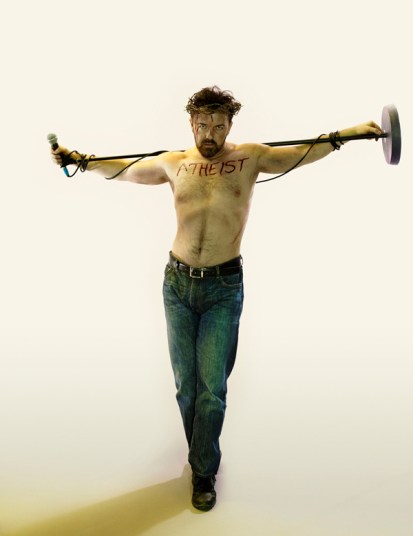
You have the right to be offended, and I have the right to offend you.
But no one has the right to never be offended
The title of this one is a little misleading, or at least cryptic. I am of course not a good Christian in the sense that I believe that Jesus was half man, half God, but I do believe I am a good Christian compared to a lot of Christians.
It’s not that I don’t believe that the teachings of Jesus wouldn’t make this a better world if they were followed. It’s just that they are rarely followed.
Gandhi summed it up really. He said, “I like your Christ, I do not like your Christians. Your Christians are so unlike your Christ.”
I have always felt this way, even when I believed in God, and in a weird way I feel I am still a pretty good “Christian” who doesn’t believe in God.
So many Christians think that because they believe in the right God, they are automatically good and have a one-way ticket to everlasting life. Dare I say it but I suspect this is their main reason for believing. I’ve heard so many “believers” say, “Well, since there is no way of being sure whether there is a God or not, it’s better to believe in God than not, because that way, if you’re wrong it doesn’t matter and if you’re right you get everlasting life.” Win:win.
This is of course Pascal’s Wager, which assumes that God if he exists would reward blind faith above logic and living a good life as an atheist.
To the Christians’ God by the way, it’s just as bad to believe in the wrong God as no God at all. The idea of other Gods is of course ridiculous to Christians. Supernatural poppycock. As if there was ever a Zeus; stupid, ancient, unenlightened superstition. And even if there are other Gods (which of course there aren’t) then the Christians’ God is the best. Hardest, smartest… just better. He would laugh at Zeus and call him a Greek bender. (I doubt that God is racist and homophobic but the Bible isn’t clear. Some bits go on about love and equality and others say you shouldn’t trust certain types and that laying down with a man as you would with a woman is punishable by death and is a bit sick and evil.)
So remember. If you are gay you are “Bumming for Satan” basically. (That would make quite a good T-shirt.)
Jesus was a man. (And if you forget all that rubbish about being half God, and believe the non-supernatural acts accredited to him, he was a man whose wise words many other men would still follow.) His message was usually one of forgiveness and kindness. These are wonderful virtues but I have seen them discarded by many so-called God-fearers when it suits them. They cherry pick from their “rulebook” basically. I have seen such cruelty and prejudice performed in the name of Christianity (and many other religions for that matter) that it makes me wonder if there has been a bit too much selective reading and reinterpretation of the doctrines.
God or not, if I could change one thing for a better world, it would be for all mankind to adhere to this little gem: “Let he who is without sin cast the first stone.” I assure you, no more stones would ever be thrown.
So maybe we should go back to basics to find out where it all got confused.
|
The Ten Commandments The 10 Commandments are found in the Bible’s Old Testament; Exodus, Chapter 20. “And God spoke all these words, saying: ‘I am the LORD your God.'” So let’s take the test. |
|
| ONE ‘You shall have no other gods before Me.’I definitely do not. Excellent. I get one point. |
TWO ‘You shall not make for yourself a carved image – any likeness of anything that is in heaven above, or that is in the earth beneath, or that is in the water under the earth.’This basically means don’t make or worship a religious statue or bow to it thinking that it’s holy. Tick. Another point to me. |
| THREE ‘You shall not take the name of the LORD your God in vain.’I never do. But let me explain something. Most people think that The Third Commandment means that they shouldn’t use his name as a swear word, e.g. shouting, “Oh God!” when they stub their toe instead of, “Oh Fuck!” This is not the case (although I love the idea that God would rather them shout “Fuck” than “God”. That makes him cool in my book. But no.) The commandment could equally be, You shall not take the name of the LORD your God in “vanity” e.g. when your enemy is hurt or defeated saying, “that’s God’s wrath,” or when you win an award saying, “thank God.” This is using his name in vanity. It’s suggesting that you KNOW that God helped you win that award because you deserved it more, or because he was on your side. It’s always tickled me that God would have a favourite actor at The Golden Globes. Anyway I get another point. I think most non-atheists will lose a point here. |
FOUR ‘Remember the Sabbath day, to keep it holy.’Before we score this we need to discover what it really means when God commands us to keep the Sabbath day holy. In understanding our answer, and the true intent of God’s word, it doesn’t matter what day of the week we celebrate the Sabbath. There were no calendars when God created the heavens and the earth so we don’t know what day he stated and ended. Don’t let the ‘day’ become more important than the ‘intent’. If we look at the portion of The Ten Commandments which refers to this, Exodus 20:8-11, it seems to be very specific; According to the Bible, God commanded us to keep it holy. But what does that really mean? Work is basically referring to that which we do to earn a living, or in working around the house, or any labour we participate in daily. So, if we never worked at all would that mean every day was holy? No. This absolutely is not being holy. In various places in the Bible we are told of our need to work, for in our work we honor God. So… basically you have to work for the equivalent of six days a week with a day off. I do this. I get another point. |
| FIVE ‘Honour your father and your mother.’I think I get a point if anyone does with this one. |
SIX ‘You shall not murder.’Nope. Tick. |
| SEVEN ‘You shall not commit adultery.’Nope. Tick. |
EIGHT ‘You shall not steal.’Nope. Tick. |
| NINE ‘You shall not bear false witness against your neighbour.’Nope. Tick. |
TEN ‘You shall not covet your neighbour’s house; you shall not covet your neighbour’s wife, nor his male servant, nor his female servant, nor his ox, nor his donkey, nor anything that is your neighbour’s.’Nope. Tick. Another point for me. |
|
|
|
Not bad for an atheist.
I make that 10 out of 10.
How did you do?
Even if this doesn’t prove I am a good Christian it does prove that the Bible is a bit inconsistent, open to interpretation, and a little intolerant.
This is not peculiar to Christianity to be fair. And I like to be fair. Because unlike ALL religions, as an atheist, I treat ALL religions equally.
Share this:


I Got Your Children’s Book Right Here

It's the perfect book to read to your children after four beers.
Share this:

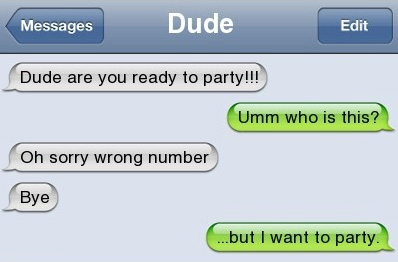

Natural Selection

If you choke laughing at someone choking on a hot dog then we’ll give you the Heimlich because we gotta keep the cool people around.
Share this:


Jewish Jester
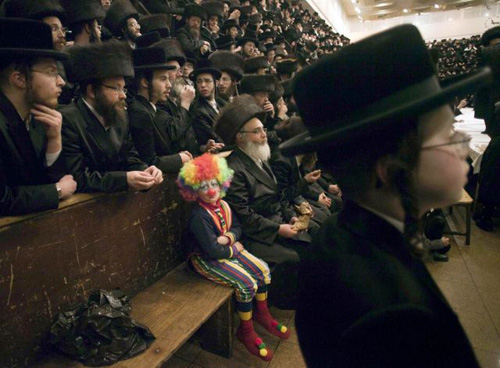
Clowning around in synagog is unacceptable, Anne Frankly I won’t stand for it.
Share this:

Batman was pulled over for speeding.

In other news, Gotham looks goddamn beautiful in the daylight. Who knew.
Share this:

Why Daylight Saving Time Is Pointless


Ugh. You’re up an hour early, your body hates you for it, and even a gallon of coffee can’t get your day on track. Daylight savings sucks. But you know the worst part? It doesn’t have to be like this.
Daylight savings isn’t as old as you think it is. First suggested by Benjamin Franklin, in 1784, it was then shot down by many very sensible people as being pointless. Then, in the First World War, it was introduced—first by the Germans—to save coal during war-time.
Somehow in that age of austerity, the concept soon caught on and everyone started doing it. Sadly, nobody’s really thought to change back. Except Arizona, and it hasn’t fallen off the face of the planet as a result.
But oddly, some people still support the use of daylight savings: they say it saves energy, promotes a healthy lifestyle, and reduces traffic accidents. So let’s bust the myths now and make it clear that daylight savings needs to go.
Daylight Savings doesn’t save energy…
The Germans introduced daylight savings to lower fuel costs. The idea is that, while changing the clocks reduces the use of artificial lighting in the evening but increases use in the morning, the evening reduction outweighs the morning increase.
Great—but that was a century ago. Recent studies point out that, at best, DST might cut the US electricity usage by 1% during March and April. Other estimates, by the National Bureau of Standards, suggest it has zero effect.
…cut accidents…
Many folks point to the fact that DST reduces the incidence of road traffic accidents as a good reason to keep using the system. In fact, the data surrounding road safety disagree widely. Some studies show that it makes no difference, others suggest a 0.7 per cent reduction in traffic fatalities during DST. When the data’s that limited, it’s not enough to base a decision on.
…or make us any healthier…
It’s true that DST does provide extra daylight in the evening, and that it may bring with it increased physical activity and reduced incidence of depression. But there is plenty of evidence that changing the clocks by an hour can have a harmful effect on our health.
Clock shifts disrupt our circadian rhythms. Studies have shown that, around the times of the spring clock changes, there are spikes in suicide rates and an increase in the number of recorded heart attacks. In fact, when Kazakhstan ditched DST in 2005, it cited health reasons. Sure, it might make you go for an extra jog or two every year, but it might also help contribute to a heart attack. I know which I’d prefer.
…but is incredibly disruptive.
So, none of the arguments for maintaining DST weigh up. I have one, very large, argument to support scrapping it, though: it loses the US billions of dollars every year. It damages retail, affects the stock market in a negative way, and even disrupts agriculture.
A century ago, we didn’t have results to tell us whether DST made a real measurable impact; it was acceptable to run with it because, for all we knew, it was useful. Now, we know better. Day light savings sucks—and we need to get rid of it.

William Willett, inventor of daylight saving time.
Share this:







Interwebs!
The internet has been commercially available for over 20 years. We live our day to day lives on it and in most cases run our businesses through it.
This brings me to one very important question that has been plaguing me for over a decade.
Why the fuck are there people who still don’t know how to use it?
 There is only one excuse/reason someone would not know how to use something as incredibly awesome, as all powerful, and as insanely important as the internet . That reason is a flat out refusal to learn. This is aggravating and ignorant.
Why should people like me have to hold hands of those choose not to learn?
“Hello? Oh hi! What do you mean you don’t know where to check your e-mail? What provider are you using? Ok, pick a provider and set up an e-mail account.”
You wanna know why IT people have such a high and mighty attitude? Because what should be common knowledge by now, isn’t. Not having basic internet skills is the like going through life without ever learning to talk and then wondering why nobody understands you.
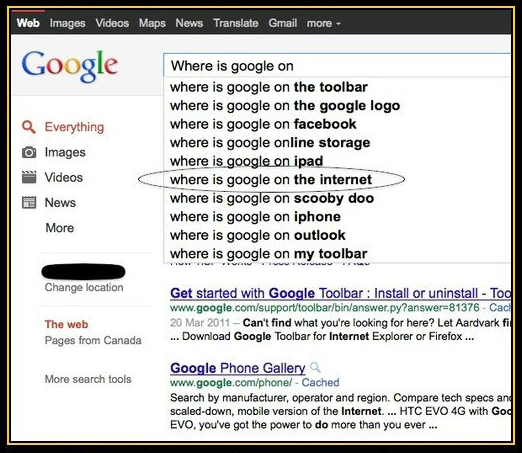
This is 2012. The Age of Information. The web is our language. Speak it or die. This isn’t directed at anyone in particular. I’ve just noticed an abundance of grown-ass people who still can’t figure out how to use a search engine…among other things. If you don’t know how to do something, Google it!
Share this:

Optimus Prime narrates for NASA
When Optimus says jump, the appropriate response for me is always “how high”. No but really though. If some transport truck transformed into a giant robot armed to the teeth with guns, then you better believe I’ll do what he says. Us bots gotta stick together, know what I’m sayin’?
As awesome as this video is (and trust me I’m already filling out my NASA application), I kept expecting Peter Cullen to say Optimus’ famous quote from the original cartoon:
“Impressive…for primitive rocket technology.”
Check out NASA’s video below narrated by the Big Boss himself. Now transform and roll out!
Share this:
She’s Ollieing for Two Now


This is what abortions will look like if Rick Santorum is elected president.
Share this:

Ten Signs You Are a Good/Unquestioning Christian
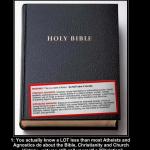
1 – You vigorously deny the existence of thousands of gods claimed by other religions, but feel outraged when someone denies the existence of your god.
2 – You feel insulted and dehumanised when scientists say that people evolved from lesser life forms, but you have no problem with the biblical claim that you were created from dirt.
3 – You laugh at polytheists, but you have no problem believing in a trinity god.
4 – Your face turns purple when you hear of the atrocities attributed to allah, but you don’t even flinch when hearing about how god slaughtered all the babies of Egypt in the book of exodus and order the elimination of entire ethnic groups in joshua, including women, children and animals.
5- You laugh at hindu beliefs that defy human and Greek claims about gods sleeping with women but you have absolutely no problem believing that the “holy spirit” impregnated Mary who then gave birth to a man god who got killed, came back to live and then ascended into the sky.
6 – You are willing to spend your time looking for little loopholes in the scientifically established age of the Earth (4.55 billion years) but you find nothing wrong with believing dates recorded by pre-historic tribesmen sitting in tents having a guess that the world is only a couple of thousand years old.
7 – You believe that the entire population of this planet with the exception of those who share your beliefs –though excluding those in all rival sects will spend eternity in an infinite hell of suffering. Yet you consider your religion the most “tolerant and loving”
8 – While modern science, history, biology and physics have failed to convince you otherwise some idiot rolling around the floor speaking in tongues may be all the evidence you need.
9 – You define 0.01% as a “high success rate” when it comes to answered prayers. You consider that to be evidence that prayer works and you think that the other 99.9% was simply the will of god
10 – You actually know a lot less than many atheists, agnostics do about the bible, christianity and church history, But still call yourself a christian
Share this:


The Rest Is Silence


Laertes
…he…may give his saying deed…no further
Than the main voice of Denmark goes withal.Claudius
Be as ourself in DenmarkHamlet
O God, I could be bounded in a nut shell and count myself a king of infinite space, were it not that I have bad dreams.Guildenstern
Which dreams indeed are ambitionHamlet
….To die, to sleep;
To sleep: perchance to dream: ay, there’s the rub;
For in that sleep of death what dreams may come
When we have shuffled off this mortal coil,
Must give us pause:
Hamlet at heart is just a student who wants to return to Wittenberg. But he cannot breach the custom that unites a king (or his heir) with his kingdom. He cannot reform his “old stock.” His choice is not his own – he is subject to the “voice of Denmark.” Both his father and his uncle want him to be like them “in Denmark.” Hamlet’s dilemma is whether “to be or not to be”…”so like the king THAT was and IS THE QUESTION of these wars.” He kills Claudius only after he knows that he himself is dying, so he can avoid inheriting the kingdom and being dragged into hell by his union with it, as Claudius was.
In the end he finallly silences the “voice of Denmark” (or at least passes it over to Fortinbras – “he has my dying voice”) – going to his final rest, free from dreams of ambition. “The rest is silence.”
Share this:

Litany Against Fear
All together now, wherever you are:
I must not fear.
Fear is the mind-killer.
Fear is the little-death that brings total obliteration.
I will face my fear.
I will permit it to pass over me and through me.
And when it has gone past I will turn the inner eye to see its path.
Where the fear has gone there will be nothing.
Only I will remain.
Share this:
Since creation is an event in time, how could god create time?
Is creation necessarily an event in time ? I realize that it seems ludicrous to suggest otherwise, but the statement in itself implies that without time and space there can be no existence or perception. Being creatures that are aware of only this existence in a dimension where time and space are integral to every thought and concept we have, it would be very hard to believe there is a reality where the rules of time and space are not so rigid (or exist at all).
Example: Prior to space and time, God decided to create space and time (and everything in it ; the universe). Even our language is designed in a way which makes it difficult to even discuss a reality that is not based on space and time. To say the word ‘prior’ in the first sentence implies there was a prior – a prior to the creation of space and time. How can we talk about before and after without time ?? The whole thing is paradoxical.
So does that mean that in a reality where time and space don’t exist, all events happen at once ? What does ‘at once’ even mean without time ? And what does the word ‘all’ mean without space ? Usually, when we say all we are summing a group of things the things are separated by space.
Very frustrating. So it seems to show that there is no world without time and space.
Then we have quantum physics. I don’t profess to be an expert about the subject, but it is interesting. If you happen to believe that the physicists of this world are knowledgeable (I do) then you might have a difficult time reconciling common sense with the world of quantum physics where the building blocks or our universe can exist in various states. Things at the subatomic level can exist in several places at once. Things can have multiple outcomes (electron can be detected at point B or point A depending on who looks at it and how). Experiments have been performed that seem to indicate that something you do right this instant can affect (at the subatomic level) something in the past. Light has recently been ‘frozen’ inside a structure and then released to become light again (much later).
Since we’re all made of subatomic particles, our bodies – the whole universe is based on things that have no concrete location (space) and can exist in multiple places at once (space and time). Couple this with the experiment where things in the past can be affected with things you do today (time) and I’m back to being frustrated again. My perception in daily life seems to indicate a world of absolutely nothing but one based on time and space yet the physicists are demonstrating that the rules of time and space are not so absolute.
A part of me likes your (Dave) argument because it just makes sense. But in light of all the rules of quantum physics, it doesn’t seem as cut and dry anymore. Maybe we’ll discover that it is possible to create time and space without having to exist in time and space. That there’s a reality outside of that. ??? That time and space is more of a perception or a side effect of simply existing in the universe in which we inhabit ???
I’m sure this post seems confused (as I usually am) and contrived but these are real suspicions that I have. But as a non-believer in God, If I had to pin myself down to a religion or belief it would have to be one of science. I know it’s not a God based religion (more of the Einstein type of religion) but I use it to try to help me decide where I might go after I die and why I’m here – and that seems to be a major part of organized religion.
So when I hear about the implausibility of a God out of time and space creating time and space, I have to take issue with it. It makes just as much sense as a purely scientific theory of everything just existing because it just exists. Or everything being created (including time – including the law of thermodynamics ?) due to the big bang (essentially something being created from nothing). Even scientific answers just seem to answer one question with a different one.
So, I don’t think it’s too surprising that people turn to religion to get answers/comfort, but I hope they consider there’s a fascinating reality right here that they can see, hear, touch and feel.
Share this:
Proof of the non-existence of a god
Some people falsely believe that it is impossible to prove the unexistence of anything, but they are wrong. It can, for example, be proved that there is no even prime number greater than two. Other people use to say that there is no way to prove if there is a god or not, or even that we cannot get any knowledge of god (agnosticism). My opinion as a strong atheist, is that we can in fact prove that god does not exist in the physical world. This document is my attempt to do so.
Definition of the word “god”
To prove the non-existence of god we first need to define the word “god”. When christians talk about god they mean an almighty being. This, I think, is the only god that holds, since it is the only god that can be logically justified.
I think it makes most sense if god is female, because only women can give life. Something that even people in the Stone Age understood. Later when wars affected the cultural evolution, and men took control of society, god became male, but the female god still lives on in the expression “Mother earth”. It should also be pointed out that an omnipotent god must be either androgyne or sexless. However, in most religions god is male so I will refer to god as ‘he’, ‘him’ etc.
Some people (Einstein for instance) believe in a god who is not a personal god, but a Spinozan kind of god. I claim that this god is not a god! To say that god is universe – by getting knowledge of the universe we get knowledge of god – is to redefine the meaning of the word god. This has nothing to do with the word god as it was defined by the “primitive” cultures which preceded our present civilization. He can be excluded with Occam’s razor, and most important: Such a god does not hear prayers.
If god is not omnipotent there is nothing that prevents him from being a product of the universe. If that is the case, what makes god divine? Then god would only be an alien, a being of matter; probably containing flesh, blood and DNA like all life we know of. Everything god is able to do would be things that human beings also will be able to do, all his knowledge would be knowledge we will also achieve. In fact humans would be gods, which should lead to some strange kind of humanism!
Many people justify their faith with god as an explanation. What is the meaning of life? Where does time and space come from? Who created the physical constants? et cetera. Because we lack knowledge of these things – and maybe never will, since they are questions like “what is the color of a second?” or “how does sound taste?” – god is there as an explanation.
Let’s say that god is the meaning of life, what then is the meaning of god? If god has a nature, who created that nature? If god created time and space, how can god exist without it? Since creation is an event in time, how could god create time? and who created god? To answer these questions god must be almighty, or else you can’t explain them. In fact you can if you say god stands above time and space and so on (which he indeed does if he is almighty), but to be able to prevent god from being tied to future phenomena, you must give him the quality of omnipotence so he can stand above everything.
The qualities of an omnipotent god
If god is almighty there are several qualities he must have. They are as follows:
He must know everything. Everything that is, everything that has been and everything that will be. To be able to know everything that will be he must know every position and every momentum of every particle in cosmos (Laplace’s “World Spirit”).
He must be worth our worship. A being that is not worth worshipping is no god.
He must be able to do anything. If there are things that god can’t do, he certainly is not omnipotent.
He must be above time. Something that even St. Augustine deduced. But not only that, god must stand above all possible dimensions.
He cannot be ‘good’ or ‘evil’ or, indeed, have any subjective characteristica. If god is all good, he cannot do evil things and cannot be almighty. Most people would object and say that good can do evil but chooses not to do it. Well, if god is all good he can’t choose to do evil things, can he?
The theodicé problem
We also have the theodice problem, stated by David Hume:
If the evil in the world is intended by god he is not good. If it violates his intentions he is not almighty. God can’t be both almighty and good. There are many objections to this, but none that holds since god is ultimately responsible for the existence of evil. Besides, if only god can create he must have created evil. If somebody else (the devil) created evil, how can one know that god, and not Satan created the universe?
The ontological evidence against gods
Neccesary in a god is a being that is worth worshipping, so if there is no being worth worshipping there cannot be a god.
Not any of the existing religions can provide such a god. How do we know if there are no undiscovered beings worthy our submission? Well if there is a being that has either failed or not tried to communicate with us that being is not worth worshipping either, so the ontological evidence against god holds, even without complete knowledge of the world.
There is a test, based on the ontological evidence against god, that you can do to try the existence of god. Pray, and ask god to provide you with a clear proof for his existence within a week. After that week, if you have got a proof that god exists, send me the evidence. If not, there are only three reasons I can think of that are plausible: (1) God does not exist, (2) God does not want to or (3) God can’t give you this evidence. Because of the ontological evidence, alternative (2) and (3) are not worth your worship and thus they equal alternative (1). So if you get no response there is no god.
The meaning of the word existence
What do we mean by existence? The very definition for existence is that a thing is said to exist if it relates in some way to some other thing. That is, things exist in relation to each other. For us, that means that something is part of our system (‘The known world’). God is defined to be infinite, in which case it is not possible for there to be anything other than god because “infinite” is all-inclusive. But if there is nothing other than god then either god cannot be said to exist for the reason just explained, or god is the known world, in which case, by definition, god is not a god.
Occam’s razor
Occam’s razor was formulated by William of Occam (1285-1349) and says: “Non est ponenda pluralites sive necessitate” or in english: “Do not multiply entities unless necessarily”. It is a principle for scientific labour which means that one should use a simple explanation with a few explanatory premises before a more complex one.
Let’s say that everything must be created, and that was done by an omnipotent god. A god which stands above time, space, moral and existence, which is self containing and in it self has it’s own cause. This entity can surely be replaced by the known world. The world stands above time, space, moral, existence, is self containing and in it has it’s own meaning. Most theists agree that god has a nature. Then we must raise the question, who created god’s nature? If we just accept that god has a nature and exists without a cause, why not say that the known world just is and that the laws of physics are what they are, without a cause?
God is not really an explanation, only a non-explanation. It is impossible to gain information from non-information so God as an explanation is a dead end. When we have said that the reason for something is that ‘god did it that way’ there is no way to understand it any further. We just shrug our shoulders and accept things as they are. To explain the unknown by god is only to explain how it happened, not why. If we are to investigate the world and build our views of life from the world, we cannot assume a god. Because adding god as an explanation leaves as many, if not more questions than it explains, god has to be removed with Occam’s razor if we are serious in investigating the world.
Some things are impossible to do:
There are things that are impossible to do. For example nobody can cover a two-dimensional surface with two-dimensional circles, without making them overlap. It is impossible to add the numbers two and two and get 666. You can not go back in time (without passing an infinite entropy barrier). The number of things that are impossible to do are almost infinite. If god were to be almighty he would be able to do them, but it’s impossible to do so.
Some people say that he can only do things that are logically possible to do, but what is? Is it logically possible to walk on water? Is it logically possible to rise from the dead? Is it logically possible to stand above time, space and all other dimensions – and still exist? I’d say that everything which violates the laws of physics are logically impossible and thus omnipotence is logically impossible. Besides if omnipotence is a relative quality there is no way to tell omnipotence from non-omnipotence. For omnipotence to be a valid expression it must be absolute, but we have no objective criteria to measure omnipotence so the word itself is useless.
Omnipotence is impossible due to paradoxes
Another way to disprove the almighty god is that omnipotence leads to paradoxes. Can god make a rock that is too heavy for him to carry? Can god build a wall that even he can’t tear down?
Also, if god knows everything, he knows what he will do in the “future” (in any dimension, not necessary the time dimension). He must have known that from the very start of his own existence. Thus god’s actions are predestined. God is tied by faith, he has no free will. If god has no free will god is not omnipotent. Another way to put it is that to be able to make plans and decisions one must act over time. If god stands above time he can not do that and has no free will. Indeed, if god stands above all dimensions god is dimensionless – a singularity, nothing, void!
Besides there can exist no free wills at all if god is almighty. If you had a free will, god wouldn’t know what you would do tomorrow and wouldn’t be omnipotent.
The void creator
If everything must have been created, then god must have been created as well. If god is not created, then everything mustn’t have a creator, so why should life or cosmos have one?
Besides this argument has another leap. If everything has a source and god is that source, then god must have existed without it before he created it. So if god created time and space, he must live outside of time and space. Thus he is non-existent. If all life must come from something and that is god, god is not alive and hence non-existent. If moral must come from god, god lacks moral. If logic comes from god, god is illogic. If nature comes from god, god is unnatural. If existence comes from god, god is non-existent. If god is the cause of everything, god is void
We would never notice god
This is not an evidence against god, but rather describes the lack of sense in praying to a god who stands above time.
If god stands above time and created time and space he can not be the first link in a time dependent chain of events. Rather he would affect every step in all chains, and we would only see god in the laws of physics (Davies, 1983, chapter 4). This god is an unnecessary entity to describe the world and should be removed with Occam’s razor
If somebody would pray to god and god would listen, the laws would change to achieve the desired result. Thus the world would be different and the prayer would never have been said. Besides god would already (in an “above time” sense of view) know that you would pray, and already have changed the world. Prayers would be totally meaningless. We would already live in the best world possible, and any prayer would be to doubt the wisdom of god.
Even worse: For every prayer said, god has not acted, or else the prayer had been undone. This means that the more people have prayed, the more bad things in the world have persisted. Therefore, the more you pray, the more evil persist (provided god exists and stands above time).
A much better way to change the world is to do it yourself. Then you would know that it was you who made the world better. The effect of prayers are not scientific provable, whilst the effect of actions are. Instead of praying you should set to work at improving your situation. This is what humanism is about.
Nobody really believes in god
Schopenhauer once said something like:
“Man can do anything he wants, but he can not want whatever he wants.”
My thesis is that people who claim to believe in god do not really do so. They just wish to believe in god. They somehow feel that their lives are meaningless without god, so they choose to close their eyes to evidence against the existence of god. The christian view is well expressed by Cardinal Ratzinger:
“Religious liberty can not justify freedom for divergence. This freedom does not aim at any freedom relative truth, but concerns the free descicion for a person to, according to his moral inclinations accept the truth.” (The times, June 27 1990, p9)
It’s as clear as it can be! For a christian you accept the “truth” according to your moral, and then have to be strong in your faith to keep your believes. You decide a priori what to believe and then try to convince yourself and others that it is true. But theists don’t really believe, because to believe something is to take it for true, and just like in Nazareth’s song Sold my soul there is no sign of god in the world. When you have the evidence for and against something your sub-conscious works on it and makes a conclusion. The process can’t be affected by your will, only delayed or suppressed, which will lead to psychoses, and those are far more common among (catholic) priests than any other group..
I have personal experience of this believing what you want to believe. When I was a child I believed in a lot of crazy things. I thought my stuffed animals were intelligent. I believed in Santa Claus. I thought there were monsters under my bed at night. I even believed in god after I heard some of the tales from the old testament. Then I became older and realized that these things weren’t true. When I look back I don’t understand how I could believe in them, it must have been that I wanted to do so. (Except for the monsters, which had to do with fear of the dark)
When many religious people are confronted with criticism of their religion they convert to atheism or agnosticism. Examples of people who became critical to the dogmas of christianity are Charles Darwin (Darwin, 1958), Dan Barker (Barker, 19??), Ernest Renan plus many former “Catholic modernists” in the 19th century such as Alfred Loisy and Antonio Fogazzaro (Baigenth, Leigh, 1991). The Catholic modernism evolved in the late 19th century and was banned in 1907 by the Vatican (Baigenth, Leigh, 1991). These people are to me clear evidence that an enlightened person will after considering the facts, reject christianity and other religions that contain deities.
Note: This is not the “Plead to authority” fallacy. I’m talking people here, who were trying to prove the existence of god and turned atheists. They did not want to do this, but had to after reading a lot of books and doing a lot of thinking on the subject.
Epilogue
I have tried to define the only god that can be philosophically justified and show some examples why this god cannot exist. After reading this document you may object and say that god is beyond human understanding and can’t be defined in scientific terms. This is the view of agnosticism.
If god is so mysterious, how can we know anything about him? Through the Bible? How do we know that the Bible and not the Koran or the Vedha books, for example, are the words of god? (or the bible if you believe in any of the other two books). Considering the cruelties that have been made in the name of god, how do we know that not all religions are made by Satan?
If there is no way to know this but to trust people who claim they have had “divine experiences” there is no way to tell true from false prophets. One has to give up his free mind and follow the authority of a dictator. Remember also that it is the person making a positive claim who has to prove it.
“I wish to propose for the reader’s favourable consideration a doctrine which may, I fear, appear wildly paradoxical and subversive. The doctrine in question is this: that it is undesirable to believe a proposition when there is no ground whatever for supposing it true.” — Bertrand Russell
“We shall not believe anything unless there is reasonable cause to believe that it is true” — Ingemar Hedenius
——————————————————————————–
References
Michael Baigent, Richard Leigh, The Dead Sea Scrolls Deception (1991)
Dan Barker, Losing Faith in Faith – From preacher to atheist (19??)
Paul Davies, God and the new physics (1983)
Share this:
How to Boost Your Reading Comprehension by Reading Smarter and More Conscientiously
With all of the things out there to read on the internet—all of the blogs we want to keep up with and all of the news funneled to us every day—how can you make sure you read each item in a way that really enriches your life? The short answer: You can’t, not without help, anyway. Here’s how you can stop, refocus, and change the way you read so you’ll take more away from it.

Photo by Kevin Dooley.
Step 1: Reconsider What Reading Really Means to You
The video at the top of this post is from the comedy Portlandia, and like any great comedy, it speaks volumes about the world we live in. If you spend any time reading the web, you’re probably at least somewhat aware of the dysfunctional relationship many of us (and possibly yourself included) have with reading. Many of us are so quick to have our say on a topic that we fail to read the articles we’re commenting on, or you’ve made the mistake of launching into a dissertation yourself when the issue you have has already been addressed. Conflicting articles, research that points in different directions, people being fooled by scams and websites that have their own bias, magazine subscriptions piling up on our coffee tables—it seems like even though there’s more information available to us, we’re absorbing less and less of it.
In fact, it’s really our relationship with reading and our ability to absorb information on a given topic that’s at issue. Do you read the magazines and blogs you do because you really love their content and appreciate what they have to say? Or do you have a love/hate relationship with what you read, where you find yourself more irritated than thrilled when you open your most visited sites, or commenting only to say how much you dislike something instead of offering your own perspective or opinions? If reading seems like a chore to you, something you feel like you have to do to keep up, then your relationship with your media needs help. We’re going to tackle that relationship one step at a time, and hopefully help you build a more positive, proactive approach to reading what you do on the internet, form your own informed ideas and opinions, and come out the other side committed to truly comprehending the things you take the time to read and enjoy.

Photo by Jayel Aheram.
Step 2: Stop, Refocus, and Build a Healthy Relationship with Reading
Stop and take stock of how you get your information. I asked Clay Johnson, author of The Information Diet: A Case for Conscious Consumption, about where this plague of poor reading comprehension came from, and he pointed out that the issue isn’t the amount of information available, or even the technology we have to bring it to our eyes, it’s that our relationship with reading needs re-evaluation. Here are three ways to stop and take stock of that relationship, and see whether what you read is really helping you think critically:
- How much do you consume? Are you trying to read every popular tech blog on the web? How many do you really engage on, comment at, or share stories from? Perhaps you’re casting your net wide because you don’t want to miss anything, or because you feel like you have to read someone to stay informed. Let go of that perception, and consider trimming your feeds to the sites you really enjoy, communities you’re actively involved in, and voices that inform and challenge your perceptions.
- Who do you read? Are your feeds full of voices that all sound the same? When was the last time you read an article you disliked, not because of a typo or because you didn’t like the topic, but because the subject matter made you uncomfortable and forced you to think about your opinion? Using politics as an example, Clay notes “If you’re wondering why Washington can’t get anything done, this model of information consumption is why: because one half of the country can choose to only hear what it wants to believe, they find the other side increasingly hard to get along with. This isn’t just political though—politics is just an obvious example. The breadth of information available, skimming or long-form, hurts our ability to dive deep into the answers to our questions if we don’t challenge ourselves to focus.” Instead, include different voices in your media consumption, and use those perspectives to inform your own.
- Is reading really the best way for you to learn? Are you spending a lot of time reading things that you feel like you should be up to date on, but just aren’t absorbing? For example, for years I subscribed to a number of SecurityFocusmailing lists because I worked in IT, was interested in security, and felt like I should be up to speed on security news and part of a community of security-minded professionals. Unfortunately, I never read the messages, eventually switched to digests to cut down on the volume, and never read the digests either. I learned everything I needed to know about security from some of my favorite security blogs and my colleagues instead. If you’re spending time skimming or reading a site, mailing list, book, or journal because you feel like you should get something from it, when there’s a more effective option for your learning style available, put down the reading material now and don’t look back.
To that last point, reading the written word isn’t the only viable way to absorb information, and as long as we assume it is, the longer we do ourselves a disservice and make it more difficult to learn new things and expose ourselves to new ideas. Clay explains, “I think we have to let go of our dogmatic relationship with “reading.” In the face of new technologies, being attached to the written word is a bit like being attached to vinyl records. Now I’m sure I’ve irritated both avid readers and avid audiophiles with this statement, but I think what we’re really after here isn’t reading comprehension but subject matter understanding and critical thinking.”
“Reading is but one thing that helps us acquire and build those skills, and one one thing that requires those skills. But it isn’t the only thing that requires those skills – it’s just one way we consume information. We tend to attach some nostalgia to “reading” as the ultimate form of information intake, superior in some kind of intellectual way to all others, but can we really say that a kid can learn more out of a textbook than from the Khan Academy? I’m not so sure.”
Step 3: Choose the Things You Spend Your Time Reading Wisely, and Include Multiple Voices
Next, reconsider the sources of information you expose yourself to. Clay pointed out that while it’s easy to assume technology has a major role in how and where we absorb information, it doesn’t define what and how we read, it’s just a means to get the information in front of us. Instead, he notes, we have the ability to be much more selective about what we read, which can lead to difficulty really understanding a topic. “Beneath the surface though, I think something else is changing our comprehension, and that’s choice.” He continues, “what’s different now than what used to be is selection and diversity, and I think that our ability to select only the information we want to hear has a really strong affect on our reading comprehension – it allows us to seek out information that confirms us more than information that informs us, making the synthesis of ideas very difficult.”
When you look through your feeds, check to see if you’re getting news from multiple trusted sources with differing viewpoints. Regardless of the topic you’re passionate about, whether it’s technology, politics, world news, economics, science, or medicine, focus on the topics you want to read about, discard the others that you skim or read because you feel like you have to (or that you get nothing out of), and then select a few trusted sources with differing viewpoints to help you stay on top of your preferred topics.
You’ll find that as you read and expose yourself to differing viewpoints, you’ll begin to build your own thoughts and opinions, form your own ideas, and even see the logic behind perspectives that differ from your own, even if you disagree. Plus, by eliminating the topics and feeds that cause you so much stress, you begin to transform your relationship with what you do read into something more positive, instead of an exercise in cleaning out an inbox.
The key here however is to make sure you pick trusted sources with different voices, and rein in your information fire hose to the topics you’re really interested in and communities you’re passionate about. Your goal at this stage is to go a mile deep and an inch wide—as in, stop trying to read every tech blog on the web and stick to the ones you really enjoy reading and challenge your opinions about the technology you love (and the technology you hate).

Photo by artotem.
Step 4: Read Conscientiously, and Take Time to Absorb and Reflect on What You Read
Once you’ve whittled down the amount of information you absorb to the things you’re really passionate about and the things you really want to read and engage with, it’s time to actually readthose things. Clay has some suggestions: “the number one piece of advice I have is to consume consciously and deliberately. Transform your relationship with information consumption into something that you do proactively, rather than something that happens to you. Once you do that, you can start applying frameworks – like the one I wrote about how to focus, and using tools like limiting your bandwidth.”
Trimming the amount of data coming through your feeds and bookmarks doesn’t mean that you should just spend less time reading, unless you plan to read less and learn more through other methods. Instead, the goal is to give you the freedom to really appreciate the things you do read about. For example, instead of reading an article and hammering out a knee-jerk reaction in the comments section so you can hurry up and move to the next unread item in your feed reader, this kind of conscious consumption allows you to stop, think over what you just read, seek out more information about topics mentioned that you don’t understand very well, think about the author’s viewpoint, and come to your own informed conclusion. Then you can engage in the discussion if you see fit, or even start your own conversation by writing an opposing or corroborating piece elsewhere, perhaps even on your own blog.
Conscientiously reading the topics you’re passionate about from a variety of voices gives you the room to think critically about what you just read. When you free yourself from feeling like opening your feed reader, inbox, or bookmarks folder is a chore to plow through, you’ll be in a better position to really appreciate what you read.

Photo by aprilzosia.
Step 5: Build a Flow Around Thoughtful Reading
Changing your relationship with the things you read isn’t a one-time process. It doesn’t require a ton of maintenance, but it does require some vigilance. After all, most of us didn’t consciously try to get to the point where we read more than we can absorb or think critically about, so it’s easy to slip back into old habits.
Before you add a new site to your feed reader, make sure you ask yourself whether you’re reading the site because you really think it’s useful and you really want to engage with the author(s) or the community. If you can’t honestly say yes, you’re probably adding it because you think it’s a site you should be reading, which is a no-no. Also, if you do add new sites and feeds to your newsreader or aggregator and find you haven’t clicked on them once, haven’t read their articles in ages, or don’t get anything valuable from them, don’t be shy with the axe. Cut them off before they start to nip at the corners of your attention span. Don’t lose sight of your goal: to stay free enough to really comprehend and analyze the things you spend your time reading, and to spend your time reading things that enrich your life.
If you start to get overwhelmed, Clay has a number of suggestions on how you can manage the flow of information you consume that are easy to apply and will save you time in the long run.
Photo by aprilzosia.

Extra Credit: Share Your Thoughts, Add Your Own Ideas
All of these steps can help you cut back on the volume of information you consume, target your reading to your interests as opposed to your responsibilities, and use the time you saved to think critically and come up with your own new ideas about the things you’ve read. The next step is to take those ideas and share them with others, if you see fit. Personally, one of the biggest benefits I derive from managing the flow of information in my life as strictly as I do is that in addition to being exposed to different ideas and having the time to really think them over, I also have the time to come up with my own viewpoints and perspectives and share them with others.
Sharing those ideas with other people does something transformative for your reading comprehension. Instead of simply being a content consumer, absorbing information where you can get it, you become a content creator, offering up your own unique opinions and ideas on a topic for others to read on their own. You’re suddenly in the same position as the people you read, wanting people to afford you the same courtesy of reading, thinking, absorbing, and then sharing their own ideas and alternatives (as opposed to rapid-fire reactions) and you’re dependant on those people for the same constructive reasoning and passionate engagement as you’re now involved in.
Even if you don’t decide to add writing to your reading and critical thinking flow, sharing your ideas and thoughts about what you’ve read with others is a great way to enrich your conversations, learn more about the people in your life, and grow based on their ideas and opinions as well.
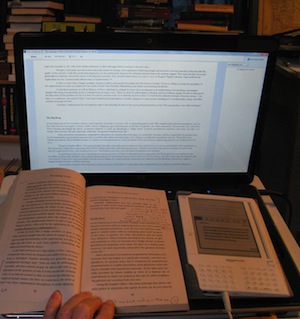
Photo by J Brew.
Footnote: Don’t Hate the Internet, Hate the Game
It would be easy to blame the internet for what appears to be a trend in people with little information and a lot to say, and in fact, some people have tried to claim that it’s access to overwhelming amounts of information at our fingertips that’s making us less interested in reading and absorbing that information and applying it to our world view. We don’t agree, and we don’t even think that the volume of information available to us is the problem, either. A lot of people spend time and money to disconnect, retreat to resorts with no internet access and out of cellular range, and escape from their personal fire hoses of information without realizing that they have complete control over the flow of water from that hose at all times.
When I asked Clay Johnson about whether the internet has a role to play here, he pointed to a 2009 study by the University of California San Diego that says we’re actually reading three times more every day than we did in 1980, and actually argued that the internet saved reading as we know it. “I think we have to think carefully about this concept that somehow our reading comprehension is actually suffering because of the Internet, because it’s fairly clear that we’re reading a lot more,” he noted. One going theory is that we’re trying to do too much at once and it’s multi-tasking that’s killing our attention spans and ability to absorb what we read. Clay noted that there may be something to that theory, but if it holds water, it’s not the internet’s fault for presenting us with a lot of data to pay attention to—in reality, it’s the way we apply and prioritize that information that needs adjustment, not the source of the information.
If anything, the wealth of information on the internet and the discussion available in all corners on all topics simply brings us face-to-face with something that’s been happening for a long time: a lot of people have a lot to say on topics they may not know very much about. The internet just makes us aware of it because it’s everywhere and we’re engaged in more discussions on more topics than ever before. In a time where there’s more information at our fingertips than there ever has been, it’s not the internet’s fault that most of us have an unhealthy relationship with reading and interacting with the things that we read.
One of the best things you can do for your reading comprehensions and for your own ability to think critically about the world around you is to recognize how valuable you time really is, and spend it reading the things that enrich your life. Take those lessons and topics, and learn to focus on them by looking for more information, building your own ideas off of them, and sharing those ideas with others.
These suggestions will help you get started, and once you start, you’ll find that your relationship with reading, both online and offline, is a much more positive, enjoyable one, as opposed to just another thing you have to check off your to-do list.
Clay Johnson is the author of the upcoming book The Information Diet: A Case for Conscious Consumption. He graciously offered his help for this story, and we thank him.
Via Alan Henry @ LifeHacker Contact Alan Henry: Email the Author


 RobDurdle.com
You must be logged in to post a comment.